





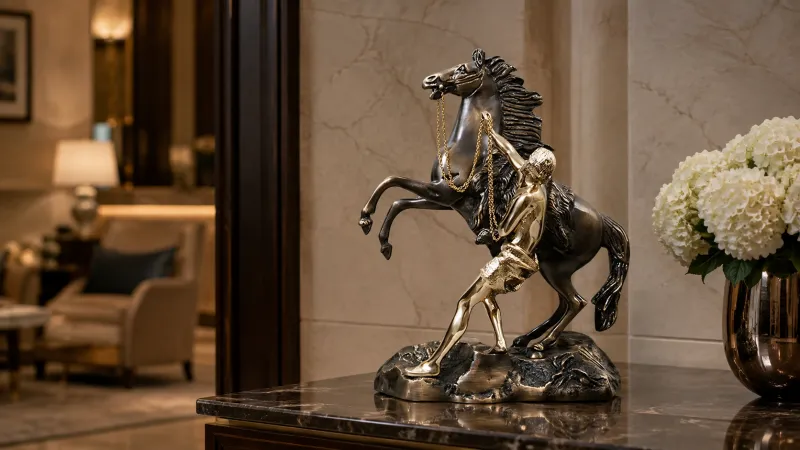
Behind the Craft: How Master Sculptors Create Luxury Bronze Sculptures
Posted by Luxury Group International Design Team / Luxury Sculptures / August 16, 2026
When someone picks up one of my small bronze sculptures for the first time, there is usually a moment of surprise.
It is heavier than expected. Cooler in the hand. The surface is not perfectly uniform like something made by a machine. Light catches differently on the polished edges, settles into the darker recesses and reveals tiny marks that you might not notice from across the room.
Those details are where my work lives.
A handcrafted bronze sculpture may be small enough to sit on a writing desk, bookshelf or console, but creating it is anything but a small process. Before you see the finished bronze, it has passed through modelling, mould-making, casting, chasing, polishing and patination. At several stages, a pair of human hands can either preserve the character of the sculpture or lose it.
That is why, when people ask me how bronze sculptures are made, I never answer simply, “We pour bronze into a mould.”
Casting is only one moment in a much longer story.
It Starts Long Before the Bronze
I rarely begin by thinking about metal.
I begin with a line.
It may be the curve of a horse’s neck, the tension in the body of an athlete, the weight of an animal standing still, or the way a figure leans slightly forward.
With a small sculpture, proportion is unforgiving. Move a leg by a few millimetres and the entire pose can feel awkward. Make the head slightly too large and the character changes. Make an expression too obvious and it loses subtlety.
So I sketch, look, change and look again.
The first three-dimensional form may be modelled in clay or wax, depending on the piece and the casting method. This is where the personality begins to emerge.
For me, this is one of the most important differences between a decorative object and a handmade art sculpture. A decorative object can simply fill a space. A sculpture needs to hold your attention from more than one angle.
Turn it around.
Does the silhouette still work?
Look at it from below.
Does the posture still feel natural?
Place it several metres away.
Can you still understand the movement?
A good handcrafted luxury sculpture has to survive all of those tests before I am willing to move forward.
Step 1: Creating the Original Model
There is a temptation, especially with small sculpture, to add too much detail.
I learned over time that detail alone does not make a piece refined.
What matters is where the detail sits.
On an animal sculpture, I may spend more time finding the correct rhythm of the back and shoulders than carving every strand of hair. On a human figure, the position of the hands can communicate more than an overworked face.
Bronze is capable of recording surprisingly fine surface detail, which is one reason it has remained such an important sculptural material.
But the bronze can only preserve what we put into the original.
When collectors talk about the character of a handcrafted luxury sculpture, much of what they are responding to was created at this very first stage.
Step 2: Making the Mould and Wax
For many detailed bronze sculptures, especially pieces produced through lost-wax casting, the original model is used to create a mould. From that mould, a wax version can be produced.
This wax is far more important than it looks.
At this point I can still refine the sculpture. I can clean an edge, strengthen a line, restore a texture or correct a tiny imperfection.
The wax is also fitted with channels that allow the bronze to enter and gases to escape during casting. In traditional lost-wax work, the wax is eventually enclosed in a heat-resistant material and removed by heating, leaving a cavity that can receive molten metal.
This is the part of how bronze sculptures are made that visitors to a finished interior almost never imagine.
They see a quiet bronze horse standing on a table.
I remember the fragile wax version that came before it.
Step 3: The Moment the Wax Disappears
There is something poetic about lost-wax casting.
You spend hours preserving a form in wax, and then that wax has to disappear.
The prepared mould is heated so the wax leaves the interior. What remains is an empty negative space — the exact shape we want the bronze to occupy.
It is one of the oldest established casting methods and remains valued because of its ability to reproduce complex forms and fine detail.
People sometimes imagine luxury craftsmanship as a very calm, polished world.
The foundry is not like that.
There is heat. Weight. Protective clothing. Tools. Darkened surfaces. The smell and atmosphere of working metal.
A handmade art sculpture may eventually stand quietly beneath beautiful lighting, but its birth is much more physical.
Step 4: Casting the Bronze
Then comes the moment everyone wants to see.
The metal is ready.
The mould is ready.
The bronze is poured.
Molten metal flows through the casting channels and into the space previously occupied by the wax. Once the bronze has cooled and solidified, the outer mould can be removed. What comes out is recognisably the sculpture — but it is absolutely not finished.
There are casting channels to remove. Surfaces to clean. Edges to refine.
Sometimes this is the point where people finally understand how bronze sculptures are made: casting does not produce a finished luxury object in one miraculous step.
It produces the material from which the next stage of craftsmanship begins.
Step 5: Chasing — Where the Hand Returns
This is one of my favourite stages.
Once the raw bronze has been cleaned, the surface is chased by hand. Chasing means working the metal after casting: removing unwanted traces of the casting process, refining joins, sharpening details and restoring textures where necessary.
On a handcrafted luxury sculpture, this is where patience becomes visible.
Imagine the eyelid of a small figure.
The edge of a horse’s ear.
The texture around a lion’s mane.
The fingers of a golfer holding a club.
At this scale, I cannot treat these areas aggressively. A fraction too much filing can change the expression or flatten a detail.
Small sculpture teaches discipline.
You learn when to touch the bronze and, equally importantly, when to leave it alone.
This hand-finishing is also one reason two genuinely handmade pieces never feel completely identical. The intention may be consistent, but the hand leaves subtle variations.
That slight individuality is not a defect.
For me, it is part of the value of a handmade art sculpture.
Step 6: Patina — Giving Bronze Its Final Voice
Raw bronze is only the beginning of the surface.
Patination is where colour, depth and mood enter.
Patinas can be created through controlled chemical reactions on the bronze surface, producing different tones and visual effects. Historically and in modern workshops, sculptors and foundries have used patination deliberately to influence the way light reveals form.
For me, patina should never simply colour the sculpture.
It should help us read it.
I may want the recesses darker so the modelling feels deeper. Raised areas may be gently polished so they catch light. Certain surfaces might remain restrained, while others are allowed to glow.
This is why I often say the final character of a handcrafted luxury sculpture is created twice: first in the form, then again in the surface.
Why Small Bronze Sculptures Demand So Much Precision
Large sculpture can impress through scale.
Small sculpture has nowhere to hide.
When a piece sits on a side table or desk, the owner may see it from less than a metre away every day. They notice the ears, fingers, expression, polished edges and transitions in the patina.
That changes how I work.
The smaller the sculpture becomes, the more carefully I think about which details deserve emphasis. Very fine elements can disappear visually, so forms need clarity without becoming exaggerated.
This is one reason I enjoy small-scale work.
You are creating something intimate.
A large sculpture can dominate a room. A small handcrafted luxury sculpture becomes something people discover. Someone walks past it, stops, looks closer and notices something they missed before.
That relationship develops slowly.
And that, to me, is luxury.
From the Workshop: What Does “Handcrafted” Really Mean?
What takes the most time?
People expect me to say the casting. Often, it is the finishing. Modelling, correcting the wax, chasing the bronze and developing the patina can demand enormous patience. The dramatic moment is pouring the metal. The quiet hours afterward are where refinement happens.
Can two bronze sculptures ever be exactly the same?
A mould can reproduce the same underlying form, but hand chasing, polishing and patination introduce small differences. That individuality is something I appreciate rather than try to erase.
What should a collector look for in a handmade art sculpture?
Look beyond the subject first. Study the surface. Look at difficult areas such as hands, faces, hooves, ears and transitions between textures. Turn the sculpture around. A well-considered piece should remain convincing from different viewpoints.
What makes a handcrafted luxury sculpture feel luxurious?
Not decoration for its own sake. Material, proportion, finish and restraint. Luxury is when the maker has spent time on details that most people will never consciously notice — yet the finished piece would feel wrong without them.
Handcrafted Luxury Sculpture Europe: Why the Atelier Tradition Still Matters
Collectors searching for handcrafted luxury sculpture Europe are often looking for more than a geographical label.
They are looking for a particular attitude toward making.
European bronze workshops have centuries of sculptural and foundry traditions behind them, from historical casting practices to the atelier systems in which sculptors worked alongside highly skilled mould makers, founders, metal finishers and patina specialists.
That spirit still matters.
A handcrafted luxury sculpture is rarely the result of one dramatic gesture. It is the accumulation of many specialist decisions.
The model must be right.
The casting must preserve it.
The chasing must respect it.
The patina must complement it.
When people search for handcrafted luxury sculpture Europe, I think this is ultimately what they hope to find: an object where the process has not been separated from the beauty.
Why Bronze Feels Different in an Interior
Bronze has presence without needing to be loud.
That is especially true of smaller sculptures.
Place one on a console and it changes as daylight moves across the room. Place it beneath warm evening lighting and the deeper patina becomes more pronounced. Pick it up and its weight immediately reminds you that this is metal, not lightweight imitation material.
A carefully chosen handcrafted luxury sculpture does not need to dominate an interior.
Sometimes its role is simply to reward the person who comes closer.
The Part of the Sculpture You Cannot See
When you look at a finished bronze, you see the surface.
I see everything underneath it.
I remember deciding whether a curve needed another millimetre of clay. I remember checking the wax. I remember the rough bronze before it was chased. I remember watching the colour change during patination and deciding when to stop.
That history remains inside the finished object, even though the collector never sees most of it.
Perhaps that is the best answer to how bronze sculptures are made.
They are made in stages, certainly.
But more importantly, they are made through decisions.
Hundreds of them.
Some technical. Some artistic. Some made in seconds and others considered for hours.
And when those decisions are made well, the final handmade art sculpture feels effortless.
That effortlessness is deceptive.
Behind it are fire, wax, metal, tools, experience, judgement and human hands.
A Small Sculpture Can Carry a Long Story
I have never believed a sculpture needs to be monumental in size to feel important.
Sometimes a small bronze figure beside a stack of books becomes the object someone remembers most clearly in a room. Sometimes an animal sculpture on a desk becomes part of a family’s home for decades. The bronze is touched, moved, viewed in different light and gradually becomes familiar.
That is what I want from a handcrafted luxury sculpture.
Not simply to be purchased.
To be lived with.
For those exploring handcrafted luxury sculpture Europe, it is worth looking closely at how a piece has been made and finished, not only at what it represents. The story of bronze is found in those small differences — the modelling, the chasing, the patina and the evidence that a human hand remained involved until the final moment.
If you would like to see how this tradition translates into pieces designed for desks, shelves, consoles and curated interiors, explore the Luxury Group International bronze sculpture collection.
Because when you understand how bronze sculptures are made, you begin to see a finished sculpture differently.
You no longer see only the bronze.
You see the hands behind it.
A Note From the Writer
Writing about bronze sculpture is different from writing about an ordinary decorative object. The more I learned about the process, the more I understood that the true value of a handcrafted piece is often hidden in the hours of work we never see.
From shaping the original form to refining the wax, casting the bronze, chasing tiny details and building the final patina by hand, every stage requires patience and judgement. With small bronze sculptures, that craftsmanship becomes even more important because the collector experiences the piece at close range.
What interested me most while putting this article together was the human side of the process. A finished bronze may look calm and effortless, but behind that surface are heat, tools, repeated adjustments and countless decisions made by skilled hands.
I hope this behind-the-scenes look helps you see a handcrafted luxury sculpture not simply as an interior accessory, but as a piece of craftsmanship with a story built into every detail.
RECENT POSTS
-
The Art of Sitting Beautifully: Upholstered Bench Designs Where Comfort Meets Craftsmanship
October 08, 2026
-
Modern Luxury Lighting Trends That Are Quietly Transforming Elegant Interiors
October 08, 2026
-
The Quiet Power of Luxury Statues: Sculptural Accents for Opulent Interiors
October 07, 2026
-

The Art of Calm: Why Elegant Bedroom Furniture Never Feels Overwhelming
October 07, 2026
-
Royal Dressing Tables: The Elegant Centrepiece of a Sophisticated Bedroom
October 06, 2026
-
The Perfect Glow: How Luxury Dining Chandeliers Transform Formal Dining Spaces
October 06, 2026
-

When Lighting Becomes Art: Luxury Chandelier Designs That Define Grand Interiors
October 05, 2026
-
The Art of Entertaining: Luxury Bar Cabinets That Turn Home Lounges Into Statement Spaces
October 05, 2026
-
The Quiet Luxury Bathroom: Why Hidden Bathtubs Are Defining 2026
October 04, 2026
-
The Timeless Allure of Round Marble Coffee Tables in Luxury Interiors
October 04, 2026