





Concealed vs Exposed: Finding the Right Thermostatic Shower Balance for Your 2026 Bathroom Vision
Posted by Luxury Group International Design Team / Luxury Bathroom Furniture / May 02, 2026
The shower has stopped being a mere utility. In 2026, it stands as a ritual space, a visual anchor, and a daily conversation between water and architecture. At the heart of that conversation sits the thermostatic shower system — the silent guardian that holds temperature steady while you breathe into the steam.But one question now splits bathroom designers more than any other: should those controls hide behind the wall or stand proudly in plain sight?
The choice between a concealed thermostatic shower and an exposed thermostatic shower is not about right or wrong. It is about personality, spatial rhythm, and how honest you want your bathroom to feel. Let us walk through both paths, then help you decide which one belongs in your 2026 vision.
When the Wall Takes Control: The Concealed Thermostatic Shower
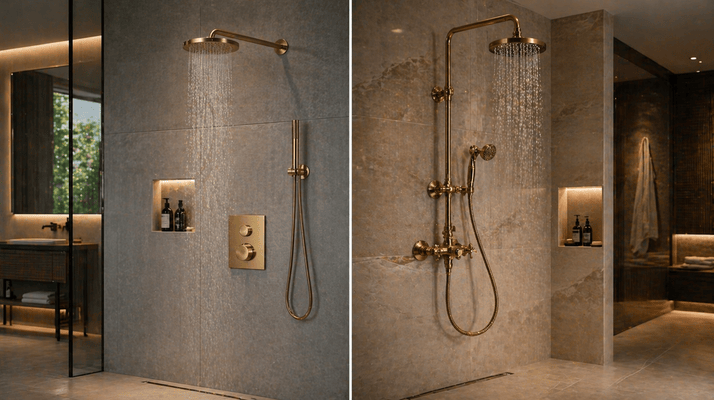
A concealed thermostatic shower buries its valve and pipework inside the wall. Only a slim faceplate and a single handle or lever remain visible. Everything else vanishes.
This design speaks the language of minimalism. It favors clean lines, uninterrupted surfaces, and the illusion that water simply arrives from nowhere. For luxury bathrooms aiming at a spa‑like, architectural look, the concealed thermostatic shower has become a signature move.
Why it shines for 2026
The current trend leans toward emotional calm. Clutter creates noise. A flush‑to‑wall control panel removes visual distraction, allowing a statement tile, textured stone, or a dramatic niche to take center stage. It also makes small or irregularly shaped showers feel larger, because nothing protrudes into the walkway.
From a practical standpoint, a concealed system is easier to clean. No pipes, no exposed brasswork, no crevices where residue accumulates. Just a smooth plate that wipes down in seconds.
Where it asks you to compromise
The hidden valve requires access planning. If maintenance becomes necessary, you open the wall. That is why a quality luxury thermostatic shower in concealed form demands expert installation and robust components. It also offers less immediate visual character — which is fine if your bathroom tells its story through materials rather than hardware.
The Honest Elegance of an Exposed Thermostatic Shower
Now consider the exposed thermostatic shower. Here, the valve body, pipework, and diverter sit visibly on the wall. The design celebrates function. Brass columns, polished curves, and industrial‑inspired levers become part of the room’s jewelry.
This approach has never truly left. In 2026, it returns with renewed confidence, especially in bathrooms that value heritage warmth over cold perfection.
Why exposed design holds its ground
An exposed thermostatic shower delivers immediate tactile presence. You see the engineering. You touch the metal. It speaks of authenticity in an age of hidden everything. For loft apartments, renovated period homes, or any space with existing pipe runs on the surface, an exposed system saves construction chaos while adding deliberate character.
Maintenance is a dream. Every junction and cartridge is right there. A plumber can service the valve without breaking tile or chasing leaks behind plaster. That transparency gives many homeowners genuine peace of mind.
The trade‑off to know
Exposed hardware occupies visual and physical space. In a very compact shower area, those prominent pipes may feel intrusive. Cleaning also takes more patience, as water spots gather on every curve and corner. And if your vision leans toward seamless, monolithic luxury, an exposed thermostatic shower may read as too busy.
At a Glance: Concealed vs Exposed Thermostatic Shower
| Aspect | Concealed | Exposed |
| Visual weight | Nearly invisible | Strong, sculptural presence |
| Cleaning effort | Minimal (smooth plate) | Moderate (multiple surfaces) |
| Installation complexity | Higher (wall access needed) | Straightforward |
| Maintenance access | Requires opening wall | Instant, no demolition |
| Best for… | Minimalist, spa, small showers | Industrial, period, loft bathrooms |
Your 2026 Decision Framework: Match the System to Your Vision
Stop asking which type is “better.” Instead, ask these three questions.
Question one: What mood do you want to wake up to?
If you crave a quiet sanctuary where your eye travels across marble veining or zellige tile without interruption, let a concealed thermostatic shower disappear into the wall. It will not compete. It will serve.
If you want a morning jolt of character — something solid, metallic, and slightly nostalgic — choose an exposed thermostatic shower. It greets you like a trusted old tool.
Question two: Is your bathroom a clean slate or a loving renovation?
New construction or a full gut renovation? Go concealed. You are building walls anyway, and you can design a dedicated access panel behind a removable tile or inside an adjoining closet. That solves the future maintenance worry.
Working with existing plumbing or keeping original wall finishes? Stay exposed. You avoid dust, demolition, and the heartbreak of damaging something irreplaceable.
Question three: How do you feel about mixing languages?
Here is where 2026 gets truly interesting. Some of the most memorable bathrooms now pair an exposed thermostatic shower valve with a concealed overhead rainhead. The contrast feels deliberate — industrial honesty below, invisible luxury above.
Likewise, you can install a concealed thermostatic shower but punctuate the room with an exposed handheld riser on a separate loop. The balance becomes a dialogue rather than a single note.
A Fresh Take: Hybrid Confidence
Do not let design tribes box you in. The strongest 2026 bathrooms borrow from both camps. Imagine a wet room with a raw concrete wall. A polished concealed thermostatic shower plate sits flush on one side. On the opposite wall, an exposed brass thermostatic shower system runs vertically, feeding a classic telephone shower. One wall whispers. The other announces.
That hybrid approach also solves practical challenges. Use concealed controls for your primary overhead shower to keep the walking lane clear. Add an exposed side valve for a handheld sprayer at wheelchair‑accessible height or pet‑washing level. Balance becomes function plus poetry.
Which Side Are You On?
Before you finalise any plan, take a moment. Walk through your bathroom in your mind. Do you see uninterrupted stone and hidden engineering? Or do you see a proud column of brass and the quiet tick of an exposed thermostatic shower lever?
Let’s settle this with a voice from the audience.
Poll: Concealed for clean lines or exposed for character?
Cast your vote in the comments. Then go one step further — share your shower style choice and why. Did you choose a luxury thermostatic shower in hidden form because of a small space? Or did exposed hardware win you over with its maintenance honesty?
These conversations help every reader refine their own 2026 bathroom vision. And they help us understand exactly what matters most to you.
The Final Balance
There is no universal answer. A concealed thermostatic shower rewards the minimalist who plans ahead. An exposed thermostatic shower celebrates the realist who loves visible craft. And a thoughtful blend of both might just define the most confident bathrooms of 2026.
What matters is that your thermostatic shower system feels intentional. Not trendy. Not safe. But yours.
So choose the path that makes you pause. The one that turns a daily shower into a small ceremony. Then build everything else around that feeling.
Now it is your turn. Concealed, exposed, or a daring mix? Drop your answer below — and tell us the one reason behind it.
RECENT POSTS
-
The Art of Hospitality on Wheels: How Luxury Trolleys Elevate Boutique Hotel Experiences
September 25, 2026
-

The Art of Grandeur: How Baroque Coffee Tables Transform Luxury Living Spaces
September 25, 2026
-
The Art of Entertaining: How Luxury Bar Furniture Transforms Sophisticated Interiors
September 24, 2026
-
The New Art of Rest: Curating a Wellness-Focused Luxury Bedroom
September 24, 2026
-
Framed Prints That Bring Effortless European Elegance to Apartment Interiors
September 23, 2026
-

How Crystal Chandelier Lighting Transforms Light, Height and Luxury Interiors
September 23, 2026
-
Sculptural Illumination: How Contemporary Floor Lamps Are Becoming Modern Art Statements
September 22, 2026
-

The Art of Choosing a Luxury Table Clock: A Guide to Size, Style & Placement
September 21, 2026
-
Elegant Wall Lamps: The Secret to Warmer, More Characterful Luxury Interiors
September 21, 2026
-

Pairing Luxury TV Units with Living Room Furniture: Create Cohesive Elegance in Modern Homes & Hotel
September 20, 2026