





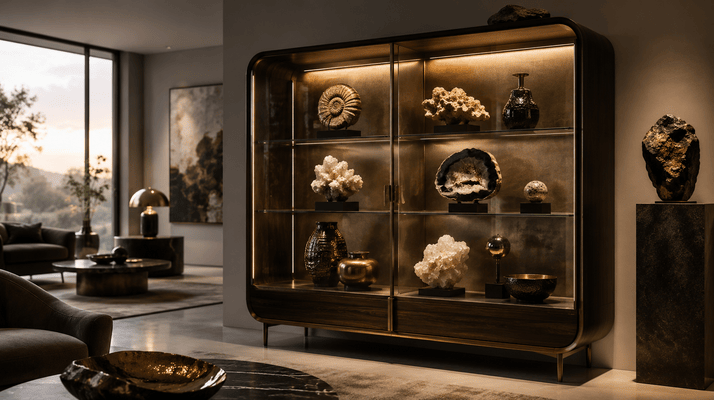
Future Fossils: Designing Modern Display Cabinets That Become Tomorrow’s Heirlooms
Posted by Luxury Group International Design Team / Living Room Furniture / May 06, 2026
Imagine the year 2075. A curious grandchild runs a finger along the edge of a glass shelf. Inside the cabinet, a ceramic vase from 2026 sits next to a handwritten recipe card. The lighting has dimmed over decades, but the carved walnut doors still close with a soft, satisfying thud. That piece of furniture is not just storage. It is a future fossil—a time capsule of how we lived, what we valued, and what we chose to preserve.Today, most furniture ends its life on a curb. Flat‑pack shelves warp, veneers peel, and pressboard crumbles within a decade. But a truly modern display cabinet built with intention can survive generations. It becomes a silent witness to family history, a sculptural anchor in a room that changes around it. This post explores how to design, choose, and care for a cabinet that will tell your story fifty years from now.
The Disposable Trap Versus the Heirloom Mindset
Walk through any big‑box furniture store. You will see “assembly required” boxes stacked to the ceiling. They are cheap, lightweight, and built to be replaced. That business model depends on you throwing things away. But a modern china cabinet should never be disposable.
Heirloom furniture starts with solid hardwood—white oak, walnut, or cherry. Joints are mortise‑and‑tenon or dovetailed, not stapled. The back panel is thick enough to hold screws without cracking. The glass is tempered or, better yet, low‑iron museum glass that does not turn green over time. These details add weight and cost today, but they guarantee that your grandchildren will argue over who inherits the piece.
The contrast could not be sharper. One shelf survives a moving truck; the other survives a single season of humidity changes.
Craftsmanship Clues That Scream “Keep Me Forever”
How do you spot a mid century modern display cabinet that will last until 2075? Look past the silhouette. Focus on the hands that made it.
Hand‑finished surfaces develop a patina, not a peel. When a craftsman rubs oil into wood grain, the finish sinks into the pores. Decades later, that surface will glow with the warmth of human touch. Machine‑sprayed polyurethane, on the other hand, sits on top like plastic wrap. It scratches white and chips in ugly ways.
Carved details matter more than you think. A simple bevel on a door frame or a fluted leg tells future historians that someone cared. Those micro‑imperfections—a slightly uneven curve, a hand‑cut dovetail—are the signatures of a maker, not a factory. In 2075, your luxury cabinets will be studied like antique Chippendale pieces are studied today.
Ask yourself: does this cabinet have hidden joinery? Are the drawer slides wooden (not metal on plastic)? Can the hinges be tightened in twenty years? If the answer is yes, you have found a future fossil.
What Stories Will Your Cabinet Tell in 2075?
Here is where the exercise becomes philosophical. Every object you place inside your modern display cabinet is a clue to your era.
That vinyl record leaning against the back panel? It says music was physical again. The small glass jar full of heirloom seeds? It whispers about a return to gardening. A handwritten letter saved from 2024? That is pure anthropology. Your cabinet becomes a diorama of early‑twenty‑first‑century life.
Now think about the cabinet itself. Fifty years from now, someone will look at its proportions and say, “Ah, the 2020s. They loved clean lines but also wanted warmth.” The slight curve on the cabinet’s apron will date it perfectly. The integrated LED strips—still working or long replaced—will tell a story about the brief moment when homes first learned to glow on command.
Contrast this with a flat‑pack shelf from the same year. That shelf will have been recycled into park benches or landfill. No stories. No heirlooms. Just waste.
Designing for Generations, Not Seasons
To build or buy a cabinet that becomes a future fossil, follow three rules.
First, choose timeless proportions over trendy shapes. A mid century modern display cabinet with tapered legs and a simple rectangular frame has already survived one revival. It will survive another. Avoid exaggerated angles or overly thin profiles that look dated in five years.
Second, prioritize repairability. A future heirloom should come apart and go back together. Screws should be standard sizes. Glass panels should be replaceable. The finish should be oil or hard wax, not a catalyzed lacquer that requires a factory to reapply. When your grandchild breaks a shelf in 2075, a local woodworker should be able to fix it.
Third, leave room for evolution. A modern china cabinet that is too specialized—“only for teacups”—becomes obsolete when tastes change. Instead, design adjustable shelves, removable dividers, and a neutral interior color like warm grey or natural maple. That way, the same cabinet can hold china in 2026, LEGO sculptures in 2040, and holographic memorabilia in 2065.
The Emotional Payoff of Owning Tomorrow’s Heirloom
There is a quiet pride in owning something that will outlive you. It shifts your relationship with consumption. You stop asking “What’s cheapest?” and start asking “What deserves to survive?”
Every time you dust your luxury cabinets, you are performing a small ritual of preservation. Every time you rearrange the objects inside, you are curating a message to the future. That act is deeply human. We have been doing it since ancient Egyptians placed grave goods in sarcophagi. A glass‑front cabinet is simply our modern version of the same impulse: I was here. This mattered.
And unlike a digital photo album that gets corrupted, your cabinet stands in a physical room. It holds weight. It reflects light. It ages gracefully.
A Challenge for Our Readers
We want to hear from you. What single object from your home today do you hope survives into the year 2075? Is it a ceramic bowl you made in a pottery class? A children’s drawing tucked behind a door? A pocket watch that belonged to your great‑grandmother?
Post your answer in the comments. Describe the object and why it deserves a place inside a future fossil. The most thoughtful responses will be featured in our next newsletter, and we will send a small care kit for your modern display cabinet to three of our favorite answers.
Because here is the truth: A cabinet is only an heirloom if someone fills it with meaning. You are the curator of 2075. Start choosing wisely today.
Final Thought
Flat‑pack furniture fills a need. But it does not fill a soul. The next time you shop for a modern china cabinet or a mid century modern display cabinet, hold the corner in your hand. Imagine your grandchild’s hand on that same corner. If you feel a future there, you have found your fossil.
RECENT POSTS
-
The Art of Hospitality on Wheels: How Luxury Trolleys Elevate Boutique Hotel Experiences
September 25, 2026
-
The Art of Grandeur: How Baroque Coffee Tables Transform Luxury Living Spaces
September 25, 2026
-
The Art of Entertaining: How Luxury Bar Furniture Transforms Sophisticated Interiors
September 24, 2026
-
The New Art of Rest: Curating a Wellness-Focused Luxury Bedroom
September 24, 2026
-
Framed Prints That Bring Effortless European Elegance to Apartment Interiors
September 23, 2026
-

How Crystal Chandelier Lighting Transforms Light, Height and Luxury Interiors
September 23, 2026
-
Sculptural Illumination: How Contemporary Floor Lamps Are Becoming Modern Art Statements
September 22, 2026
-
The Art of Choosing a Luxury Table Clock: A Guide to Size, Style & Placement
September 21, 2026
-
Elegant Wall Lamps: The Secret to Warmer, More Characterful Luxury Interiors
September 21, 2026
-
Pairing Luxury TV Units with Living Room Furniture: Create Cohesive Elegance in Modern Homes & Hotel
September 20, 2026