








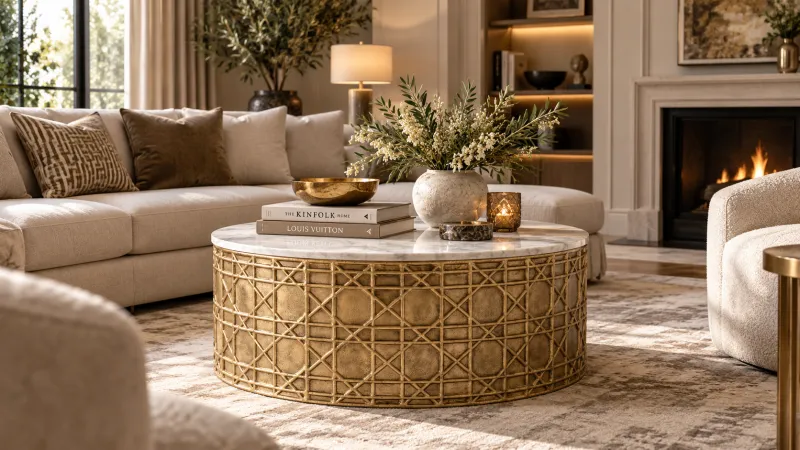
Round vs Square Coffee Tables for Family Living Rooms: Which Shape Works Best?
Pubblicato da Alessandro Conti / Mobili per il soggiorno / October 17, 2026
A family living room rarely stays perfectly arranged throughout the day. In the morning, it may be a quiet place for coffee. By afternoon, children are playing on the rug, cushions have moved, and toys are scattered around the sofa. In the evening, the same room becomes a comfortable space for everyone to relax.
This is why choosing a coffee table involves more than finding a beautiful design. The shape of the table affects how easily people move around it, how much space it provides and how well it fits with your seating arrangement.
When comparing a round vs square coffee table for family living spaces, both shapes have their advantages. The best choice depends on your room size, sofa layout, children's ages and everyday activities.
This guide will help you choose a coffee table that combines comfort, practical design and the refined appearance expected in a luxury home.
1. Why Coffee Table Shape Matters in a Family Living Room
A coffee table often sits in the busiest part of the living room. Family members walk around it, children play nearby, and guests use it for drinks and small accessories.
The wrong shape can make the room feel crowded, even when the table itself is beautiful.
Round coffee tables have curved edges and allow people to move around them naturally. Square coffee tables offer straight sides and a larger, clearly defined surface within their overall footprint.
For families with young children, these differences become particularly important.
A family friendly coffee table should provide enough usable surface while leaving comfortable space for movement.
It should also match the surrounding furniture rather than interrupt the natural flow of the room.
2. Round Coffee Tables: More Freedom to Move
One of the biggest advantages of a round coffee table is its curved shape.
Without projecting corners, people can walk around it more easily, especially in rooms where the space between the sofa and nearby furniture is limited.
This makes round designs particularly attractive for family living rooms with active children.
A child moving across the room is less likely to strike a sharp corner when the coffee table has a continuous rounded edge. However, rounded furniture can still cause injuries, so choosing a stable design and supervising young children remains important.
Round coffee tables also create a softer appearance.
Their curved outlines work beautifully with upholstered sofas, lounge chairs and contemporary furniture featuring organic shapes.
For luxury interiors, a round marble or concrete coffee table can become an elegant centrepiece without making the seating area feel overly structured.
When Is a Round Coffee Table a Good Choice?
A round coffee table is particularly suitable when:
- Children frequently play near the seating area.
- The living room has limited walking space.
- Sofas and armchairs form a relaxed seating arrangement.
- The furniture features curved or organic designs.
- You prefer a softer appearance without projecting corners.
For many households with young children, a well-designed round table is an appealing option when considering the best coffee table shape for children.
3. Square Coffee Tables: More Space for Family Activities
Square coffee tables are popular because they provide a balanced shape and a generous usable surface.
Their straight edges make it easy to arrange books, serving trays, decorative objects and other everyday items.
For families who enjoy board games, puzzles or shared activities, this extra surface can be useful.
Square designs work particularly well with large sectional sofas and spacious seating arrangements.
When placed in front of an L-shaped sofa, a square coffee table can fill the central space and provide convenient access from different seats.
This makes it a practical choice for larger family living rooms.
However, square tables have four corners that extend into the surrounding walking area.
In homes with toddlers or young children, these corners deserve additional attention. Rounded-corner square designs can offer a useful compromise between practical surface space and softer edges.
When Is a Square Coffee Table a Good Choice?
A square coffee table is often suitable when:
- The living room is spacious.
- The seating arrangement includes a large sectional sofa.
- Family members regularly use the table for games or activities.
- You need generous space for trays and everyday accessories.
- The room features straight-lined contemporary furniture.
A square table is especially useful when the household values a broad working surface alongside decorative appeal.
4. Round vs Square Coffee Table: Which Is Safer for Children?
Safety is an important consideration when selecting furniture for a family home.
Round coffee tables are generally preferable when the main concern is avoiding sharp projecting corners.
Their continuous edges reduce the risk of contact with a pointed corner during play.
Square coffee tables, particularly those with sharp stone or metal edges, may present a greater risk of injury if a child falls against them.
However, the shape alone does not determine whether a table is suitable for children.
The table's stability, height, weight and edge construction are equally important.
A heavy concrete table should not tip or shift easily. A glass table should use appropriate safety glazing and comply with relevant furniture requirements.
For households with very young children, selecting a low, stable coffee table with smoothly finished edges is often sensible.
The best coffee table shape for children is therefore not simply the roundest design. It is a table that combines suitable edges, sound construction and enough surrounding play space.
5. Which Shape Provides Better Surface Space?
When comparing a round vs square coffee table for family use, the amount of available tabletop space matters.
A square table generally offers more surface area than a round table with the same overall width.
For example, a square table measuring 80 × 80 cm provides 6,400 square centimetres of surface area.
A round table measuring 80 cm in diameter provides approximately 5,027 square centimetres.
This means the square design offers around 27% more tabletop surface than the round design in this example.
For families who regularly place snacks, books, games and decorative accessories on the table, this difference may be useful.
However, a larger surface is not always necessary.
If the coffee table is mainly used for drinks, books and a small decorative arrangement, a round design may provide more than enough room.
The ideal choice depends on how the family actually uses the living space.
6. Matching Coffee Table Shape with Your Sofa Layout
The relationship between the coffee table and sofa is essential for a balanced living room.
A beautiful table can look out of place when its proportions do not suit the surrounding seating.
Round Coffee Tables with Curved Sofas
Round tables work naturally with curved sofas, rounded armchairs and informal seating arrangements.
Their circular shape complements soft upholstery and creates a relaxed central area.
They can also be attractive in compact living rooms where several seating pieces face one another.
Square Coffee Tables with L-Shaped Sofas
Square coffee tables often work well with L-shaped sectional sofas.
Their straight sides follow the geometry of the sofa, while the broad tabletop provides access from different seating positions.
In a large luxury living room, this arrangement can feel organised and comfortable.
Coffee Tables with Two Facing Sofas
When two sofas face each other, both shapes can work.
A round table creates a softer central feature, while a square table offers a more structured arrangement.
For widely spaced sofas, the distance from each seat to the table is often more important than the shape itself.
7. How Much Space Should You Leave Around a Coffee Table?
A good coffee table should feel accessible without blocking movement.
As a practical starting point, leave approximately 40–45 cm between the coffee table and the front of the sofa.
This usually provides room for seated people to reach the tabletop while allowing enough space for their legs.
For main walking routes, aim for approximately 75–90 cm of clear space where possible.
In family living rooms, extra space may be useful when children regularly play on the floor.
A large square coffee table might provide more surface area but reduce the available walkway.
A round table of similar overall width can make it easier to move around its curved sides.
Before purchasing, measure the entire seating area rather than looking only at the coffee table dimensions.
8. Choosing Materials for a Luxury Family Living Room
Both round and square coffee tables are available in beautiful materials suited to European luxury interiors.
Marble coffee tables provide an elegant appearance and work well in formal living rooms. However, their weight, hard edges and sensitivity to certain spills should be considered.
Wooden coffee tables offer a natural finish and suit both classic and contemporary interiors. Smoothly finished wooden edges can be especially practical for everyday family use.
Concrete coffee tables introduce sculptural shapes and textured surfaces. Their substantial construction makes correct placement, stability and floor protection particularly important.
Glass coffee tables create a lighter visual effect but require careful consideration in households with young children.
For a family friendly coffee table, material quality, easy maintenance and suitable edge finishing are just as important as appearance.
9. What About Luxury Hotels and Private Family Suites?
Coffee table selection also matters in hospitality interiors.
Luxury hotels often furnish family suites, private lounges and connecting rooms where guests of different ages share the same space.
A round coffee table can help maintain comfortable circulation in compact hotel suites.
Square coffee tables may be more suitable for larger private lounges where additional tabletop space is useful.
In luxury villas and private residences, the decision often depends on the style of the surrounding furniture.
Traditional interiors may feature carved wooden tables, while contemporary spaces often use marble, concrete or metal designs.
The important point is to choose a table that supports everyday comfort without compromising the room's overall design.
Explore complementary seating and lounge furnishings from our luxury hotel furniture collection to create a balanced and welcoming interior.
10. Final Verdict: Round or Square Coffee Table for Families?
So, which shape is better?
For families with toddlers or younger children, a round coffee table is often the more practical choice. Its curved edges avoid projecting corners and can allow easier movement through busy seating areas.
For families with older children, larger living rooms and regular shared activities, a square coffee table may offer greater convenience thanks to its spacious tabletop.
Neither option is automatically better for every home.
A carefully chosen family friendly coffee table should complement the sofa layout, provide sufficient surface space and allow people to move comfortably.
Whether you prefer the softer shape of a round table or the structured appearance of a square design, the best choice is one that makes everyday family life easier while maintaining the character of your interior.
Explore our luxury coffee table collection to find elegant designs for contemporary homes, private residences and luxury hospitality spaces.
POST RECENTI
-

What Size Dresser Fits Your Bedroom? A Simple Measurement Guide
October 20, 2026
-

Swivel vs Fixed Bar Stools: Which Is Better for Everyday Use?
October 20, 2026
-

How to Protect Luxury Outdoor Furniture Through Winter: A Complete Care Guide
October 19, 2026
-

How Luxury Furniture Delivery Works Across Europe: A Complete Shipping Guide
October 19, 2026
-

How to Clean and Protect a Marble-Top Table: A Complete Care Guide
October 18, 2026
-

How to Clean a Crystal Chandelier Without Damaging the Finish
October 18, 2026
-

Dining Table Size Guide: How Many Chairs Fit Without Feeling Cramped?
October 17, 2026
-

Round vs Square Coffee Tables for Family Living Rooms: Which Shape Works Best?
October 17, 2026
-

Il Nuovo Linguaggio dell'Intrattenimento Domestico: Mobili da Bar Moderni per Interni Raffinati
October 16, 2026
-

La Luce Perfetta per Ogni Ambiente: Guida alla Scelta della Lampada da Terra Ideale
October 16, 2026


