





Onyx, Marble & Porcelain Luxury Vases: Premium Materials That Define Sophisticated Interiors
Posted by Luxury Group International Design Team / Luxury Home Accessories / March 29, 2026
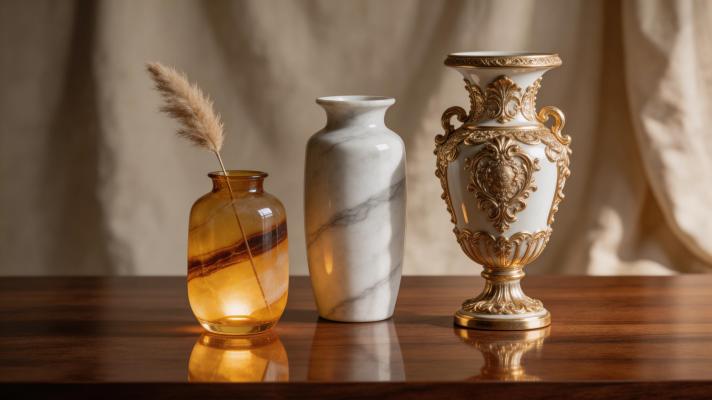
The vase you choose broadcasts your values before you speak.Walk into a room anchored by a luxury onyx vase glowing from within, or a luxury white marble vase catching afternoon light with geological depth, and the message is immediate: this space understands permanence. This collector distinguishes between decoration and investment, between trend and timelessness.
But material literacy matters. Genuine sophistication requires understanding why these specific substances—onyx, marble, porcelain Baroque urns, and stone-finish ceramics—command premium positioning in 2026 interiors. Their value isn't arbitrary. It's geological, historical, and sensory.
Here's the complete education.
Onyx: The Stone of Inner Light
Geological Rarity
Onyx forms through millennia of calcite deposition in cave systems, creating translucent bands that capture and release light like no other stone. The finest luxury onyx vase specimens—particularly Fayum S from Egypt's ancient quarries—display honey-to-amber translucency with minimal veining interruption.Unlike marble's surface reflection, onyx possesses depth illumination. Place a tea light inside a hollow luxury stone finish vase carved from genuine onyx, and the material itself becomes the light source. The stone glows. The room transforms.
Why It Feels Premium
- Visual weight without heaviness: Translucency creates paradoxical lightness in substantial objects
- Warmth retention: Unlike cold marble or clinical glass, onyx radiates amber tones that flatter skin and textiles
- Rarity signaling: Genuine onyx availability decreases annually; Egyptian quarries produce limited quantities
- Tactile temperature: Maintains ambient warmth, inviting touch and handling
Identification & Care
| Authenticity Marker | Imitation Red Flag |
| Natural banding variation | Perfectly uniform layers |
| Weight substantial for size | Unnaturally light |
| Warmth to touch | Cold or plastic-like temperature |
| Subsurface depth when backlit | Surface-only patterning |
Care protocol:
- Clean with pH-neutral stone cleaner only; acids etch calcite permanently
- Avoid direct sunlight exposure; UV degrades translucency over decades
- Display with integrated lighting or position to catch natural raking light
- Handle by base, not rim; onyx cleaves along natural planes if stressed
White Marble: The Classical Standard
Geological Character
True luxury white marble vase specimens derive from metamorphosed limestone—calcite crystals recrystallized under immense heat and pressure. The finest examples, from Carrara's Apuan Alps or Greece's Pentelic quarries, display:
- Background purity: Consistent white or warm cream base without gray clouding
- Veining as signature: Delicate gray or gold lines that prove natural origin
- Subsurface depth: Light penetrates slightly before reflecting, creating living luminosity
Why It Commands Premium Position
Marble's luxury association spans three millennia—Phidias sculpted the Parthenon frieze from Pentelic marble; Michelangelo selected Carrara blocks by personal inspection. This heritage creates cultural capital that manufactured materials cannot replicate.
A luxury vase carries this lineage into contemporary interiors. It references antiquity without pastiche. It suggests education, travel, and discernment.
Selection Hierarchy
| Grade | Characteristics | Interior Application |
| Statuario | Bold, dramatic veining, pure white ground | Statement pieces, solo display |
| Calacatta | Thick gold/gray veining, warm undertones | Traditional luxury settings |
| Carrara C | Fine, feathery gray lines, accessible luxury | Everyday sophistication, grouping |
| Thassos | Crystalline white, minimal veining | Minimalist/contemporary spaces |
Care Essentials
Marble is calcium carbonate—chemically vulnerable. Luxury stone finish vase care requires:
- Immediate blotting of acidic substances (wine, citrus, vinegar); etching occurs within minutes
- Annual professional resealing for porous varieties
- Felt or leather bases to prevent surface scratching on display furniture
- Rotation every six months; marble develops patina unevenly under directional light
Porcelain Baroque Urns: Ceramic Alchemy
Historical Mastery
The porcelain baroque urn represents Europe's centuries-long pursuit of Chinese ceramic secrets. Meissen's 1710 breakthrough—true hard-paste porcelain—enabled forms previously impossible: paper-thin walls, intricate relief carving, translucent bodies that rang when struck.
Baroque styling specifically—swirling acanthus, cherubim, architectural elements—demonstrated technical virtuosity. Each porcelain baroque urn required multiple firings, hand-applied gilding, and master sculptors working in ceramic rather than stone.
Why Contemporary Interiors Still Choose Them
- Scale without weight: Massive visual presence, manageable physical mass
- Surface complexity: Glaze chemistry creates depth impossible in stone
- Historical continuity: References 17th-18th century collecting traditions
- Adaptability: Survives environments (humidity, temperature fluctuation) that damage organic materials
Authenticity Markers
Genuine luxury onyx vase and porcelain collections demand verification:
| Porcelain Quality Indicator | Mass-Production Equivalent |
| Hand-applied relief depth | Molded, shallow surface detail |
| 22k+ gold luster, slightly irregular | Uniform metallic paint |
| Thin walls transmitting light | Opaque, heavy construction |
| Base markings indicating manufacturer and date | Generic stamps or absence |
Display & Preservation
- Secure earthquake putty or museum wax for earthquake-prone regions
- Avoid direct sunlight; gilding fades, glazes craze
- Dust with soft natural-bristle brushes; compressed air drives particles into relief crevices
- Never immerse; porous unglazed bases absorb moisture
Stone-Finish Ceramics: The Contemporary Evolution
Technical Innovation
Advanced ceramic engineering now produces luxury stone finish vase surfaces indistinguishable from geological materials—at reduced weight and increased durability. These aren't imitations. They're interpretations.
Manufacturers achieve this through:
- Mineral-inlaid glazes: Actual stone particles suspended in glass matrices
- Reactive firing: Controlled atmosphere kilns creating crystalline surface structures
- Hand-finishing: Artisan variation preventing machine-perfect uniformity
When to Choose Stone-Finish Over Solid Stone
| Scenario | Recommendation |
| High-traffic areas, children present | Stone-finish ceramic; impact resistance |
| Outdoor/seasonal display | Stone-finish; freeze-thaw stability |
| Rental or transitional spaces | Stone-finish; investment proportionate to commitment |
| Permanent collection, generational intent | Solid onyx or marble; authenticity appreciates |
| Weight-restricted surfaces (glass shelves, antique furniture) | Stone-finish; structural safety |
Styling Philosophy: The Material Dialogue
Sophisticated interiors don't mix materials randomly. They create conversation.
The Warm Palette: Luxury onyx vase + brass elements + cognac leather + warm wood tones. Amber light, intimate scale, evening orientation.
The Cool Authority: Luxury white marble vase + chrome + glass + gray textiles. Daylight optimization, clarity, intellectual luxury.
The Historical Layer: Porcelain baroque urn + antique mirrors + silk damask + gilded frames. Narrative depth, collecting tradition, provenance signaling.
The Contemporary Ground: Luxury stone finish vase + concrete + linen + blackened steel. Accessible sophistication, urban relevance, practical luxury.
Investment Reality: Cost Structures & Value Retention
| Material Category | Entry Investment | Premium Specimens | Value Trajectory |
| Onyx (Fayum S) | €800-2,500 | €5,000-15,000+ | Appreciating; quarry depletion |
| White marble | €400-1,200 | €3,000-8,000 | Stable; established market |
| Porcelain Baroque | €600-1,800 | €4,000-25,000 (antique) | Antique appreciating; contemporary stable |
| Stone-finish ceramic | €200-600 | €1,500-3,000 | Depreciating; replaceable technology |
The Sophistication Test
Genuine material literacy reveals itself in three questions:
- Does it feel right? Temperature, weight, surface variation
- Does it age well? Patina development, damage vulnerability, restoration possibility
- Does it mean something? Provenance, craftsmanship story, cultural continuity
The luxury onyx vase that passes—illuminated, warming, irreplaceable—earns its position. The porcelain baroque urn that survives centuries—delicate yet enduring—proves ceramic's claim to permanence. The luxury white marble vase that develops character—etched, stained, beloved—becomes family narrative.
Material education isn't snobbery. It's stewardship. These objects outlast us. Our responsibility is choosing worthy successors.
RECENT POSTS
-
The Art of Sitting Beautifully: Upholstered Bench Designs Where Comfort Meets Craftsmanship
October 08, 2026
-
Modern Luxury Lighting Trends That Are Quietly Transforming Elegant Interiors
October 08, 2026
-
The Quiet Power of Luxury Statues: Sculptural Accents for Opulent Interiors
October 07, 2026
-
The Art of Calm: Why Elegant Bedroom Furniture Never Feels Overwhelming
October 07, 2026
-
Royal Dressing Tables: The Elegant Centrepiece of a Sophisticated Bedroom
October 06, 2026
-
The Perfect Glow: How Luxury Dining Chandeliers Transform Formal Dining Spaces
October 06, 2026
-
When Lighting Becomes Art: Luxury Chandelier Designs That Define Grand Interiors
October 05, 2026
-
The Art of Entertaining: Luxury Bar Cabinets That Turn Home Lounges Into Statement Spaces
October 05, 2026
-
The Quiet Luxury Bathroom: Why Hidden Bathtubs Are Defining 2026
October 04, 2026
-
The Timeless Allure of Round Marble Coffee Tables in Luxury Interiors
October 04, 2026