





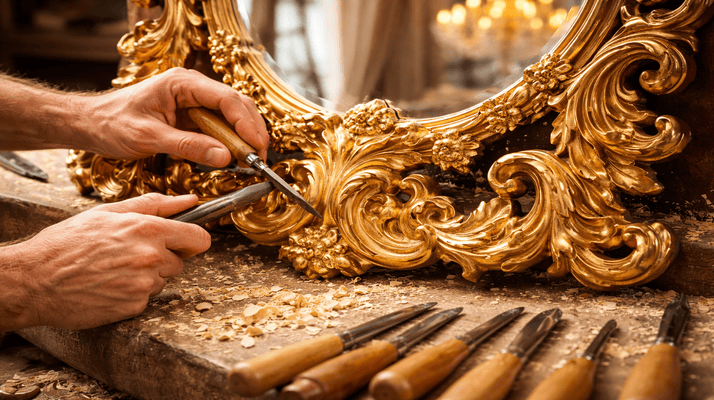
The Craftsmanship Behind a Luxury Baroque Mirror: What Hand-Carving Really Means
Posted by Luxury Group International Design Team / Luxury Apartment Interior / March 13, 2026
When you stand before a genuine baroque mirror, you are not simply looking at your reflection. You are looking at hundreds of hours of skilled labour, centuries of artistic tradition, and a level of material precision that no machine can fully replicate.Yet in today's market, the word “ornate” is everywhere. Retailers stamp it on flat-press MDF frames with polyurethane mouldings and call it a day. So what actually separates a genuine hand-carved baroque mirror from an imitation? The answer lies in the process — and once you understand it, you will never look at a decorative mirror the same way again.
The Foundation: Why Solid Wood Changes Everything
Every authentic antique baroque mirror begins with a solid wood substrate. Craftsmen typically use lindenwood (also known as limewood) or high-density hardwoods — materials with the right grain density for fine, detailed carving without splintering.
Mass-produced ornate mirrors, by contrast, are built on compressed particle board or MDF. These materials cannot hold fine detail under a carving chisel — which is why their “frames” are always pressed, cast, or glued on, not carved.
The choice of wood is not decorative. It is structural. It determines whether a frame will hold its detail for 10 years or 100.
The Art of Relief Carving: Turning Wood Into Sculpture
Relief carving is the technique that defines the visual personality of a baroque mirror. A skilled artisan uses a series of hand gouges, chisels, and veining tools to cut motifs directly into the wood surface — creating depth, shadow, and dimension that photograph beautifully and look even more extraordinary in person.
Common Baroque Motifs and What They Represent
The motifs carved into a baroque mirror frame are not random. Each one carries heritage from 17th and 18th century European court design:
• Acanthus leaves — derived from ancient Greek architecture; a symbol of immortality and enduring beauty
• Shell crests (cartouche) — a hallmark of high Baroque and Rococo courts, representing divine power and prestige
• Leaf scrollwork — flowing, asymmetric curves that give baroque design its characteristic sense of movement and opulence
• Floral embossing — delicate raised petal and vine work that adds texture and femininity to larger frames
These are not applied stickers or cast resin add-ons. On a genuine gold baroque mirror, each of these details is cut, shaped, and refined by hand — often over many sessions.
The Gold Leafing Process: Thin as a Breath, Durable as History
After carving, the frame goes through a multi-stage gilding process. This is where most people are surprised to learn just how labour-intensive real gold leafing is.
Genuine gold leaf is hammered to a thickness of roughly 0.1 microns — so thin it is translucent. Applying it requires still air, careful hands, and a fine brush called a gilder’s tip. A single misdirected breath can destroy a section.
Before the leaf goes on, the wood is coated in gesso — a mixture of chalk and rabbit skin glue — and sanded smooth across multiple layers. This creates the ultra-flat base the gold needs to adhere properly and reflect light evenly.
Bole-Ground Gilding: The Secret Behind Deep, Warm Gold Tones
One of the most distinctive techniques in high-end baroque mirror making is bole-ground gilding. A layer of natural clay — called bole — is applied beneath the gold leaf. The colour of the bole dramatically affects the final appearance of the gilded surface.
Red bole, for example, creates a warm, antique depth beneath the gold — giving the mirror a rich, aged patina that catches the light with extraordinary warmth. This is the technique behind the red bole-ground gilt patina finish seen on some of the most commanding pieces in authentic baroque mirror collections.
Yellow bole produces a brighter, crisper gold. Grey or black bole creates a cooler, more antiqued silver-like effect. Each is a deliberate artistic choice, not a shortcut.
Bevelled Glass: The Final Detail That Elevates Everything
A hand-carved frame deserves equally considered glass — and that means bevelled glass.
Bevelling is the process of grinding and polishing the edge of the mirror glass at a precise angle — typically between 15 and 45 degrees. The result is a subtle prismatic border around the reflection that refracts light, adds visual depth, and gives the piece its distinctly premium finish.
Flat-cut glass has a straight, abrupt edge. Bevelled glass has a graduated, jewel-like border. The difference is immediately visible — and in a luxury interior, these details are exactly what discerning eyes notice.
Mass-Produced vs. Hand-Carved: Spotting the Difference
Here is a practical guide to distinguishing a genuine hand-crafted ornate mirror from a factory imitation:
• Run your finger along the carvings. Hand-carved detail has subtle irregularities — no two scrolls are perfectly identical. Cast resin is always perfectly uniform.
• Look at the gilding in raking light. Authentic gold leaf catches light in a warm, multi-dimensional way. Spray-painted or foil-finished frames look flat and metallic.
• Check the weight. Solid hardwood with gesso and genuine gold leaf is heavier than MDF with acrylic paint. Lift, and you will feel the difference.
• Examine the glass edge. A bevelled edge indicates considered craftsmanship throughout. A plain, cut-straight edge suggests cost-cutting elsewhere too.
Why Craftsmanship Matters in a World Full of Imitations
There is a deeper reason why people are drawn to an authentic baroque mirror beyond aesthetics. It is the knowledge that a human being invested skill, time, and artistry into its creation.
In an era of mass production and digital shortcuts, owning something genuinely handmade carries meaning. A hand-carved, gold-leafed baroque mirror is not just wall décor. It is a craft object with a history of technique behind every curve, every scroll, and every shimmering surface.
That is why the finest baroque mirrors are measured not just in centimetres, but in the hours that shaped them.
See the hand-crafted difference in our baroque mirror collection.
RECENT POSTS
-

The Art of Hospitality on Wheels: How Luxury Trolleys Elevate Boutique Hotel Experiences
September 25, 2026
-

The Art of Grandeur: How Baroque Coffee Tables Transform Luxury Living Spaces
September 25, 2026
-

The Art of Entertaining: How Luxury Bar Furniture Transforms Sophisticated Interiors
September 24, 2026
-
The New Art of Rest: Curating a Wellness-Focused Luxury Bedroom
September 24, 2026
-
Framed Prints That Bring Effortless European Elegance to Apartment Interiors
September 23, 2026
-

How Crystal Chandelier Lighting Transforms Light, Height and Luxury Interiors
September 23, 2026
-

Sculptural Illumination: How Contemporary Floor Lamps Are Becoming Modern Art Statements
September 22, 2026
-
The Art of Choosing a Luxury Table Clock: A Guide to Size, Style & Placement
September 21, 2026
-
Elegant Wall Lamps: The Secret to Warmer, More Characterful Luxury Interiors
September 21, 2026
-

Pairing Luxury TV Units with Living Room Furniture: Create Cohesive Elegance in Modern Homes & Hotel
September 20, 2026