





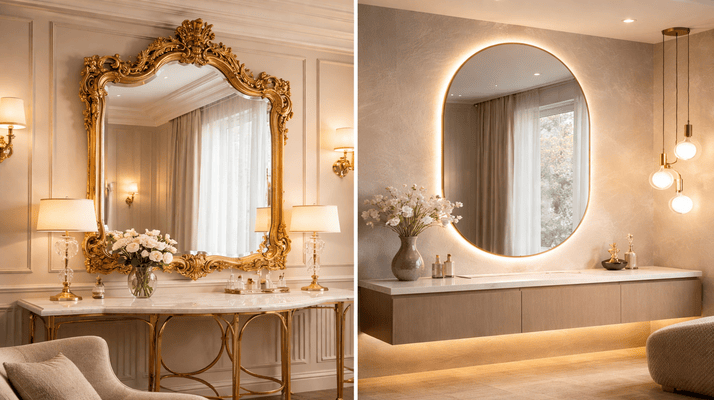
Baroque vs Modern Luxury Mirrors: Which Style Will Dominate Your Home in 2026?
Posted by Luxury Group International Design Team / Luxury Home Accessories / March 25, 2026
A well-chosen mirror does more than reflect. It anchors a room, shapes perception, and quietly declares a design philosophy. As interiors evolve toward greater personal expression, the choice between ornate Baroque grandeur and sleek modern minimalism has become one of the most compelling decisions in luxury home design. Each style carries a distinct visual language, and understanding their strengths is the first step toward a decision that feels both current and enduring.Baroque Mirrors: Opulence in Every Curve
The baroque mirror is a celebration of craftsmanship and drama. Originating in 17th-century Europe, this style is defined by elaborate frames—deep carvings, gilded finishes, and sweeping curves that command attention. A large baroque mirror transforms an entryway or dining room into a space of unmistakable presence, its intricate details catching light and creating shadows that shift throughout the day.
What makes a baroque mirror so enduring is its ability to function as art. Where other pieces recede, it announces itself. In contemporary interiors, designers increasingly use these ornate pieces to introduce contrast—pairing them with clean-lined furniture or neutral palettes to create tension that feels intentional rather than dated. The key lies in letting the mirror be the singular statement, allowing its richness to elevate everything around it.
For rooms meant to impress—formal living areas, grand foyers, or dining rooms where entertaining takes center stage—a baroque mirror delivers unmatched gravitas. Its presence suggests history, craftsmanship, and a willingness to embrace beauty without apology.
Modern Mirrors: Precision and Restraint
At the opposite end of the spectrum, modern mirrors prioritize clarity, proportion, and understatement. Clean lines, frameless profiles, or subtle metallic borders define this category. These pieces are not about decoration but about enhancement—amplifying light, expanding spatial perception, and complementing architecture rather than competing with it.
The appeal of modern mirrors lies in their versatility. A well-placed modern mirror in a bedroom or corridor makes the space feel larger without adding visual clutter. In open-concept layouts, these reflective surfaces help define zones while maintaining flow. Their restraint also makes them ideal for layering; they work seamlessly alongside art, furniture, and accessories without overwhelming.
For homeowners who favor calm, uncluttered environments, modern mirrors offer a way to introduce functional elegance that supports the overall design rather than dominating it. They are the choice of those who believe true luxury often whispers.
Room by Room: Where Each Style Excels
Selecting between a baroque mirror and a modern counterpart often comes down to the personality of the space itself.
Entryways welcome either approach, but for dramatically different reasons. A large baroque mirror above a console creates an immediate sense of occasion—a preview of the refinement that awaits beyond. A modern mirror in the same location offers a cleaner greeting, ideal for homes where simplicity and spaciousness are the primary goals.
In living rooms, consider how the mirror will interact with existing furniture. A baroque mirror pairs beautifully with traditional or transitional pieces, adding texture and warmth. Modern mirrors complement contemporary sofas and minimalist shelving, reinforcing a cohesive, unbroken aesthetic.
Bedrooms benefit from the tranquil effect of modern mirrors, particularly when placed opposite windows to draw in natural light. Yet a baroque mirror above a fireplace or dressing table introduces an element of quiet luxury—a daily reminder that beauty belongs in private spaces too.
The Hybrid Approach: Blending Old and New
One of the most compelling trends emerging in luxury interiors is the intentional blending of Baroque and modern elements. A large baroque mirror hung against a wall of clean architectural lines creates a focal point that feels both classic and refreshingly unexpected. Similarly, a collection of smaller modern mirrors arranged in a gallery style can bring structure to a space anchored by traditional furniture.
This hybrid approach allows homeowners to honor the craftsmanship of historical styles while embracing the clarity of contemporary design. The result is a space with depth—one that feels curated over time rather than assembled from a single catalog.
Which Style Will Dominate 2026?
Predicting a single dominant style overlooks the nuance of how luxury interiors are evolving. Rather than a universal shift toward one aesthetic, 2026 is shaping up to be the year of confident personal expression. For some, that means the enduring drama of a baroque mirror. For others, it means the quiet sophistication of modern mirrors. And for many, it means finding ways to let both coexist.
What matters most is not following a trend but selecting a luxury mirror that resonates with the way you live. The right mirror should feel like it has always belonged—whether it announces itself with gilded flourishes or quietly expands the space with reflective grace.
What is your mirror personality? Do you lean toward the ornate drama of Baroque or the understated elegance of modern design? Share your thoughts in the comments, and explore our curated collection of luxury mirrors to find the piece that speaks to your space.
RECENT POSTS
-
The Art of Hospitality on Wheels: How Luxury Trolleys Elevate Boutique Hotel Experiences
September 25, 2026
-
The Art of Grandeur: How Baroque Coffee Tables Transform Luxury Living Spaces
September 25, 2026
-
The Art of Entertaining: How Luxury Bar Furniture Transforms Sophisticated Interiors
September 24, 2026
-
The New Art of Rest: Curating a Wellness-Focused Luxury Bedroom
September 24, 2026
-
Framed Prints That Bring Effortless European Elegance to Apartment Interiors
September 23, 2026
-
How Crystal Chandelier Lighting Transforms Light, Height and Luxury Interiors
September 23, 2026
-
Sculptural Illumination: How Contemporary Floor Lamps Are Becoming Modern Art Statements
September 22, 2026
-
The Art of Choosing a Luxury Table Clock: A Guide to Size, Style & Placement
September 21, 2026
-
Elegant Wall Lamps: The Secret to Warmer, More Characterful Luxury Interiors
September 21, 2026
-
Pairing Luxury TV Units with Living Room Furniture: Create Cohesive Elegance in Modern Homes & Hotel
September 20, 2026