





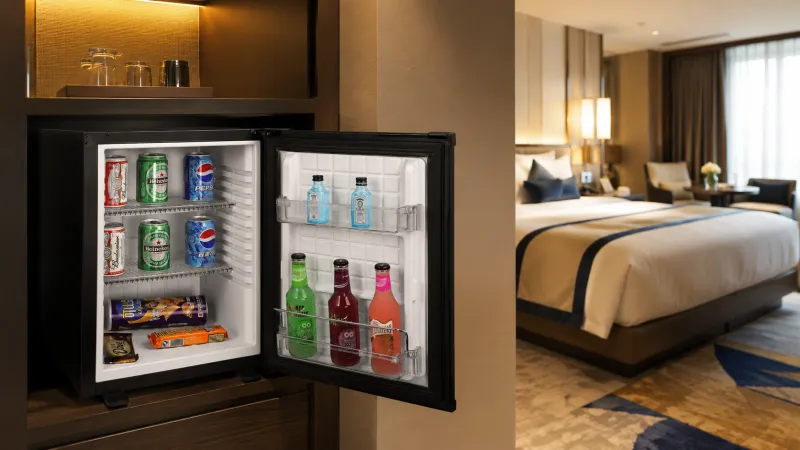
Beyond the Hum: Why Silent Hotel Minibars Are Becoming the New Luxury Standard
Posted by Luxury Group International Design Team / Hotel Equipments / July 24, 2026
A guest may never compliment a minibar for being quiet—but they will immediately notice when it is not. At 2:00 a.m., inside a carefully designed suite, even a faint compressor hum can feel louder than the room’s entire interior concept. That is why modern hotel minibars are being judged not only by capacity, finish and cooling performance, but also by what guests cannot hear.
For luxury hotels in 2026, silence is no longer a technical extra. It is part of the sleep experience.
The Quiet-Room Test
A home refrigerator usually sits in a kitchen, far from the bed. A mini bar for hotel use is different: it may be positioned beneath a desk, integrated into a wardrobe or installed only a few metres from a sleeping guest.
Compressor-driven refrigeration can produce normal humming during cooling cycles. Thermoelectric systems, however, use solid-state cooling without a conventional moving compressor, enabling compact and remarkably quiet operation.
LGI’s luxury hotel minibars are developed around this specific hospitality challenge. The collection includes 20, 28, 30 and 40-litre formats, allowing properties to match the minibar size with standard rooms, executive rooms and larger suites.
Its 40-litre model combines zero-noise thermoelectric cooling with electronic thermostat control, integrated LED lighting, automatic defrost and built-in or freestanding installation flexibility.
Technology Lens: Thermoelectric vs Compressor
Thermoelectric cooling uses the Peltier effect to move heat through a solid-state system. Because there is no conventional compressor repeatedly cycling on and off, the unit can operate without compressor hum or disruptive vibration. Fewer mechanical components also mean fewer moving parts exposed to wear.
Compressor cooling remains useful where stronger refrigeration or consistently lower temperatures are essential. However, that additional cooling power involves a motorised system, operating cycles and more potential sound.
The specification question is therefore not simply, “Which minibar gets coldest?” It is, “Which technology best protects the guest experience?”
|
Hotel Requirement |
Thermoelectric Minibar |
Compressor Minibar |
|
Night-time sound |
Near-silent operation |
Hum or cycling may occur |
|
Vibration |
Minimal |
Possible during operation |
|
Cooling intensity |
Suitable for drinks and amenities |
Stronger low-temperature cooling |
|
Mechanical complexity |
Fewer moving parts |
More mechanical components |
|
Best placement |
Bedrooms, suites and quiet zones |
Noise-tolerant environments |
Why Silence Has Commercial Value
Luxury is often measured through small moments: uninterrupted sleep, a calm suite and hotel furnitures that function without demanding attention. A noisy minibar can undermine premium bedding, acoustic treatments and thoughtfully designed hotel interiors.
Silent hotel minibars help protect the atmosphere that the property has already invested in creating. Reduced vibration can also limit bottle rattle and sound transfer into surrounding cabinetry—particularly valuable in boutique hotels, compact rooms and older European buildings.
This makes a thermoelectric mini bar for hotel rooms more than a convenient appliance. It becomes part of the property’s acoustic design strategy.
The 2026 Procurement Checklist
Hotel owners, designers and procurement teams should evaluate luxury hotel minibars alongside other essential hotel furnitures. Capacity, ventilation, cabinetry integration, thermostat control, internal lighting and visual presentation remain important—but silence should sit near the top of the checklist.
LGI’s thermoelectric hotel minibars demonstrate how one carefully selected product can improve guest comfort without changing the visible design scheme.
The most advanced form of luxury is sometimes not what the guest sees. It is the disturbance they never experience.
RECENT POSTS
-
The Art of Entertaining: How Luxury Bar Furniture Transforms Sophisticated Interiors
September 24, 2026
-
The New Art of Rest: Curating a Wellness-Focused Luxury Bedroom
September 24, 2026
-

Framed Prints That Bring Effortless European Elegance to Apartment Interiors
September 23, 2026
-

How Crystal Chandelier Lighting Transforms Light, Height and Luxury Interiors
September 23, 2026
-

The Art of Choosing a Luxury Table Clock: A Guide to Size, Style & Placement
September 21, 2026
-
Elegant Wall Lamps: The Secret to Warmer, More Characterful Luxury Interiors
September 21, 2026
-
Pairing Luxury TV Units with Living Room Furniture: Create Cohesive Elegance in Modern Homes & Hotel
September 20, 2026
-

CEO Office Design: Desk and Executive Chair Ideas for a High-End Corporate Interior
September 20, 2026
-

How to Choose a Living Room Side Table: 5 Design Rules | The Golden Ratio Guide
September 19, 2026
-

Why Boutique Hotels Are Investing in Classic Marble Statues for Lobbies and Gardens
September 19, 2026