





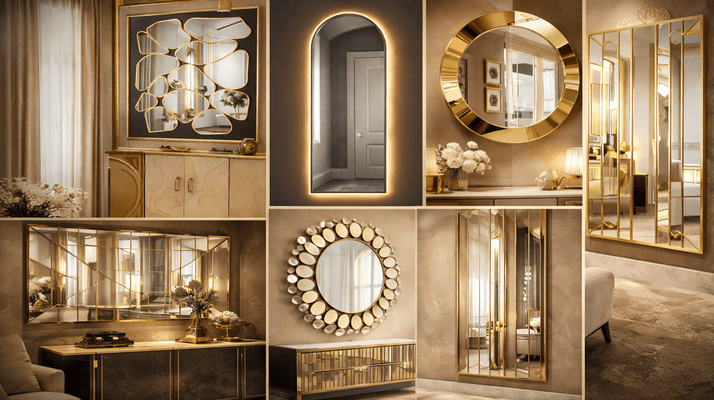
Beyond Trends: 6 Architectural Mirror Designs That Will Define Good Taste for the Next Decade
Posted by Luxury Group International Design Team / Luxury Apartment Interior / February 13, 2026
There's a peculiar feeling when you walk into a room and encounter a mirror that stops you in your tracks. It's not just a reflective surface—it's a piece of architecture, a sculptural statement that captures light, frames space, and quietly announces that every element of this room was considered with intention.In 2026, the conversation around luxury wall mirrors has shifted dramatically. After years of watching trends cycle through at breakneck speed—the organic wave, the Hollywood glam resurgence, the brief but intense obsession with mirrored furniture—discerning homeowners and designers are asking a different question. Not "What's new?" but "What will last?"
As we look toward the next decade, certain mirror designs are emerging not as fleeting fads, but as enduring architectural elements. These are pieces that don't just reflect your image—they reflect your taste.
Let's explore the six architectural mirrors that never date, the designs that will define good taste well beyond the trend cycles of 2026.
1. The Perfect Circle: Enduring Geometry
The round mirror has transcended trend status to become something more fundamental: an architectural archetype. In 2026, large circular mirrors are dominating hospitality design precisely because they feel both modern and timeless .
What makes the circle so enduring? Unlike rectangular mirrors that define the boundaries of a wall, circular mirrors seem to float within the space, allowing the wall finish behind them to breathe. They introduce curvature that softens the rigid geometry of most rooms, creating visual balance without demanding attention.
For architects and designers working on high-end hotel projects, the large round vanity mirror has become essential for creating that elusive sense of calm . The same principle applies in residential spaces. A perfectly proportioned circle in a burnished brass or minimalist frameless finish acts as a visual "portal," drawing the eye toward the center of the wall rather than the corners, making even compact spaces feel more expansive.
The Timeless Appeal: The circle is fundamental geometry. It never dates because it was never "of" any particular era.
How to Choose: Look for mirrors with substantial presence—diameters of 36 inches or more—in finishes that will patina beautifully over time. Avoid trendy colors or overly decorative elements that might anchor the piece to a specific moment.
2. The Refined Arch: Classical Proportions, Modern Sensibility
There's something inherently gracious about the arched form. It whispers of grand European corridors and sun-drenched Mediterranean villas, yet when executed with clean lines and minimal ornamentation, it feels utterly contemporary.
The arch mirror represents what design experts are calling "refined classicism"—a move away from excess and toward intention . This isn't the heavily ornamented Baroque revival of a few seasons ago. This is the arch stripped to its essence: pure proportion, elegant silhouette, nothing more.
What makes the arch so enduring is its architectural integrity. It doesn't rely on decorative flourishes for impact. Instead, it derives its power from geometry itself—the satisfying relationship between the curved top and the straight sides, the way it draws the eye upward, the natural sense of balance it brings to a room.
The Timeless Appeal: The arch has been a fundamental architectural element for millennia. It carries cultural memory while feeling completely of the moment.
How to Choose: Seek clean profiles in natural materials—oak, walnut, or simple metal frames. The power is in the shape itself, not the decoration applied to it.
3. The Sculptural Statement: When Mirror Becomes Art
The line between functional object and autonomous artwork has never been more blurred. The most exciting modern wall mirrors being produced today are those that function first as sculpture and second as reflection.
Consider the Palm Mirror, a striking piece that embodies the essence of organic modernism. Its asymmetrical silhouette is framed by a combination of dark wood and a distinctive palm leaf-inspired texture, echoing the natural movement and layered structure of dried palm bark . As light interacts with its surfaces, subtle variations in tone and texture emerge, transforming the wall into a canvas of organic elegance.
These are not mirrors you buy to check your reflection before leaving the house. These are mirrors you buy because they complete a room, because they introduce texture and depth and conversation. They work because they're confident enough to be both functional and purely expressive.
The Timeless Appeal: Great sculpture doesn't date. When a mirror is conceived as an art object first, it transcends functional obsolescence.
How to Choose: Trust your response to the piece itself, not its alignment with current trends. The best sculptural mirrors feel like they could have been made fifty years ago or fifty years in the future.
4. The Horizontal Horizon: Expanding Space Through Design
As urban luxury apartments continue to prioritize square footage efficiency, the horizontal mirror has emerged as an architectural solution to spatial challenges. But the best examples go beyond simple function to become genuine design statements.
The horizontal mirror acts as a modern "horizon line" within a room, visually widening the space and creating a sense of expansiveness . When positioned correctly—typically above a sofa, console, or bed—it establishes a stabilizing axis that organizes everything around it.
What separates the timeless horizontal mirror from the merely functional is proportion. The most successful examples are substantial—extending across a significant portion of the wall—and thoughtfully detailed. They might feature subtle beveling, integrated lighting, or frames that play with light and shadow through wire-brushed detailing or quartered veneers .
The Timeless Appeal: The horizontal line is inherently stabilizing. It speaks to our fundamental need for visual order.
How to Choose: Look for proportions that feel generous rather than minimal. A horizontal mirror that's too small for its wall will always look like an afterthought.
5. The Frameless Paradox: Invisible Yet Essential
There's a particular sophistication to the mirror that refuses to announce itself. The frameless architectural mirror—often large-scale, often custom-fabricated—represents the ultimate expression of confidence in design.
These mirrors don't compete. They don't assert. Instead, they dissolve into walls, amplifying light and space without drawing attention to themselves. They're the choice of designers who understand that sometimes the most powerful statement is the one you barely notice.
The frameless mirror works because it's pure function elevated to architecture. It requires impeccable installation—perfectly flush to the wall, seamless edges, proportions that relate precisely to the surrounding architecture. When done right, it doesn't look like a mirror you bought. It looks like a mirror the room was born with.
The Timeless Appeal: By refusing to participate in style cycles, the frameless mirror exists entirely outside them.
How to Choose: This is not a category for compromises. Work with specialists who can fabricate exactly what your space requires.
6. The Layered Composition: Radical Symmetry Through Mirror Grouping
Perhaps the most interesting development in timeless interior design for 2026 is the move toward what designers call "radical symmetry"—using multiple mirrors in deliberate, structured arrangements to create composed environments.
This isn't the haphazard gallery wall of the past decade. This is intentional, architectural composition. Think identical round mirrors flanking a console in perfect symmetry. Think a grid of square mirrors creating rhythm and order on a large wall. Think three arched mirrors of graduating size arranged along a corridor.
What makes this approach timeless is its reliance on order rather than ornament. When you arrange mirrors with geometric precision, you're not following a trend—you're engaging with fundamental principles of balance and proportion that have guided design for centuries . The result feels calm, grounded, and intentionally composed.
The Timeless Appeal: Symmetry is hardwired into human perception. We find it satisfying because our brains process balanced arrangements more easily .
How to Choose: Start with identical mirrors for the most powerful effect. The repetition of form creates the impact, not variety.
The Materials That Endure
Across all six of these architectural approaches, certain materials consistently appear in mirrors designed to last:
Burnished brass and unlacquered bronze develop patina over time, growing richer and more beautiful with age. They don't look "dated" because they were never trying to look "new."
Natural oak and walnut bring warmth that synthetic finishes can't replicate. The slight variations in grain ensure each piece is genuinely unique.
Silvered bronze and antiqued glass treatments add depth while feeling historically grounded .
The Trend That's Already Fading
To understand what makes a mirror timeless, it helps to recognize what isn't. The high-glam, high-shine furniture of recent years—excessively reflective surfaces, heavy ornamentation, obvious luxury—has fallen out of favor with designers who find it "a bit dated and heavy-handed" .
The shift is toward understated elegance: sleek lines, natural materials, and a vibe that feels effortless rather than achieved . If a mirror looks like it's trying too hard to be noticed, it probably won't be noticed for long.
Building a Collection That Lasts
The mirrors you choose for your home should do more than reflect the present moment. They should connect you to something larger—to the pleasure of fine craftsmanship, to the satisfaction of perfect proportion, to the quiet confidence of owning something made to endure.
We understand that the best mirrors aren't purchased for a single season or a single home. They're collected over a lifetime, moving from room to room, house to house, accumulating meaning as they go.
Explore our Exclusive Lighting Collection and discover luxury wall mirrors designed not for the moment, but for the decade—and beyond.
Ready to Find Your Architectural Mirror?
Book a complimentary digital design consultation with our specialists. We'll help you select pieces that will define your space for years to come.
RECENT POSTS
-
The Art of Hospitality on Wheels: How Luxury Trolleys Elevate Boutique Hotel Experiences
September 25, 2026
-
The Art of Grandeur: How Baroque Coffee Tables Transform Luxury Living Spaces
September 25, 2026
-
The Art of Entertaining: How Luxury Bar Furniture Transforms Sophisticated Interiors
September 24, 2026
-
The New Art of Rest: Curating a Wellness-Focused Luxury Bedroom
September 24, 2026
-
Framed Prints That Bring Effortless European Elegance to Apartment Interiors
September 23, 2026
-
How Crystal Chandelier Lighting Transforms Light, Height and Luxury Interiors
September 23, 2026
-
Sculptural Illumination: How Contemporary Floor Lamps Are Becoming Modern Art Statements
September 22, 2026
-
The Art of Choosing a Luxury Table Clock: A Guide to Size, Style & Placement
September 21, 2026
-
Elegant Wall Lamps: The Secret to Warmer, More Characterful Luxury Interiors
September 21, 2026
-
Pairing Luxury TV Units with Living Room Furniture: Create Cohesive Elegance in Modern Homes & Hotel
September 20, 2026