





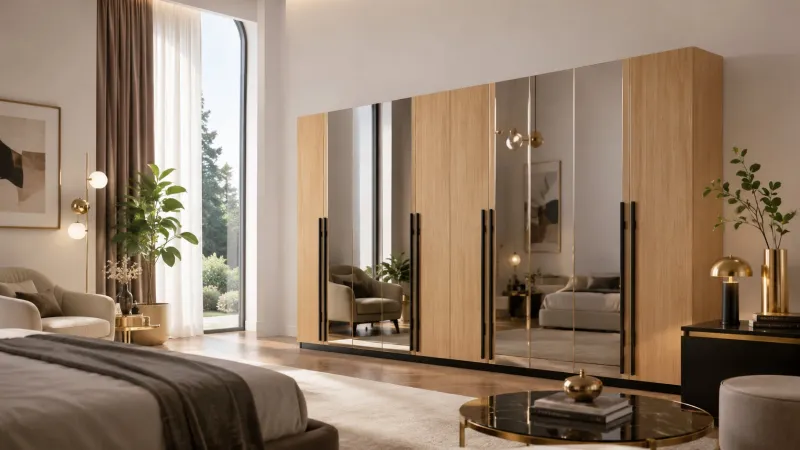
From Algorithm to Armchair: How AI Is Redefining Custom Hotel Furniture
Posted by Luxury Group International Design Team / Luxury Hotel Interior / August 21, 2026
Custom furniture has always been one of the clearest ways for a hotel to express identity. The problem is that bespoke pieces traditionally require long design cycles, repeated prototypes, material sampling, and expensive revisions. Today, AI furniture design and parametric design are changing that process by allowing designers to explore more options, test dimensions faster, reduce waste, and create highly distinctive custom hotel pieces without treating every item as a one-off experiment.
For luxury hotels across Europe, this shift could make personalisation more scalable—and potentially much smarter.
AI Furniture Design Speeds Up Early Concept Development
One of the biggest advantages of AI furniture design is speed during the concept stage.
Designers can already use generative tools to explore silhouettes, material combinations, finishes, and style directions before committing to technical development. A hotel might test dozens of variations of a lounge chair, bedside table, or reception console in a fraction of the time required for manual sketching alone.
This does not remove the role of the designer. Instead, AI can act as an accelerated ideation tool.
For luxury hotel furnitures, that means more visual exploration before production begins, helping design teams identify stronger concepts earlier and reduce unnecessary revisions later.
Parametric Design Makes Mass-Customisation Practical
While AI helps generate ideas, parametric design is especially powerful when dimensions and components need to change repeatedly.
A parametric model can be built around adjustable rules: width, height, leg position, storage capacity, surface thickness, or upholstery dimensions. Change one parameter, and the design updates automatically.
This is ideal for custom hotel pieces used across multiple room types.
For example, one bedside table design could be adapted for standard rooms, suites, accessible rooms, and compact urban rooms without rebuilding the model from scratch.
The result is consistency with flexibility—something luxury hotel groups often struggle to achieve.
Waste Reduction Starts Before Production
Technology can also improve material efficiency.
With digital modelling, nesting software, and CNC-based production, components can be arranged more efficiently on timber panels, stone slabs, metal sheets, or upholstery patterns. Designers can test dimensions before manufacturing and identify where excess material is being created.
For luxury hotel furnitures, even small improvements can matter when hundreds of units are being produced.
AI-assisted planning can also help compare material usage across design alternatives, making sustainability part of the design process instead of an afterthought.
What Production Timelines Can Look Like
Exact timelines vary enormously by supplier, material, quantity, and level of customisation, but digital workflows can reduce delays at the early stages.
A traditional bespoke furniture process might involve several weeks of concept refinement, technical drawings, sampling, prototyping, approvals, and production preparation. With AI furniture design and parametric design, concept and revision phases can often be compressed because variations are generated and adjusted digitally.
A realistic project may still require weeks or months from final approval to installation, especially for complex custom hotel pieces, but the difference is that less time can be lost redesigning basic geometry or correcting avoidable specification issues.
Technology improves the process; it does not eliminate craftsmanship, testing, logistics, or quality control.
Does Technology Make Custom Furniture Cheaper?
Not always—but it can make customisation more efficient.
A unique hand-built prototype may still cost more than standard catalogue furniture. However, once a parametric model is developed, creating multiple size variations can become more economical than designing each piece independently.
That can reduce design hours, sampling waste, and revision costs.
For hotel groups ordering large quantities, the strongest financial benefit may come from repeatability. One intelligent design system can generate a family of related products rather than requiring separate development for every room category.
Tools Designers Can Already Use
Hotels and designers do not need futuristic software laboratories to explore this approach.
Generative visualisation tools can support concept exploration. CAD and BIM platforms with parametric functionality can manage dimensions and components. Grasshopper-style modelling workflows can create rule-based furniture forms, while CNC and digital fabrication systems translate approved designs into production-ready parts.
Combined intelligently, these tools allow AI furniture design to move from inspiration into practical manufacturing.
The Future Is Bespoke—But More Intelligent
The real promise of parametric design is not that every hotel room will contain futuristic furniture. It is that customisation can become more precise, repeatable, and responsive.
For luxury hospitality, this opens exciting possibilities: headboards designed around unusual architecture, tables adjusted to specific room footprints, modular seating adapted across suite categories, and signature custom hotel pieces that remain recognisably part of one brand.
The future of luxury hotel furnitures may therefore be neither fully handmade nor fully automated.
It will be a collaboration between human creativity, digital intelligence, advanced manufacturing, and craftsmanship—allowing hotels to create furniture that feels genuinely unique without making every design decision start from zero.
RECENT POSTS
-
The Art of Entertaining: How Luxury Bar Furniture Transforms Sophisticated Interiors
September 24, 2026
-
The New Art of Rest: Curating a Wellness-Focused Luxury Bedroom
September 24, 2026
-
Framed Prints That Bring Effortless European Elegance to Apartment Interiors
September 23, 2026
-
How Crystal Chandelier Lighting Transforms Light, Height and Luxury Interiors
September 23, 2026
-
The Art of Choosing a Luxury Table Clock: A Guide to Size, Style & Placement
September 21, 2026
-
Elegant Wall Lamps: The Secret to Warmer, More Characterful Luxury Interiors
September 21, 2026
-
Pairing Luxury TV Units with Living Room Furniture: Create Cohesive Elegance in Modern Homes & Hotel
September 20, 2026
-
CEO Office Design: Desk and Executive Chair Ideas for a High-End Corporate Interior
September 20, 2026
-
How to Choose a Living Room Side Table: 5 Design Rules | The Golden Ratio Guide
September 19, 2026
-
Why Boutique Hotels Are Investing in Classic Marble Statues for Lobbies and Gardens
September 19, 2026