





Inside the Workshop: The 200‑Hour Journey of An Executive Desk (From Rough Timber to White Glove Del
Posted by Luxury Group International Design Team / Luxury Office & Study Furniture / April 30, 2026
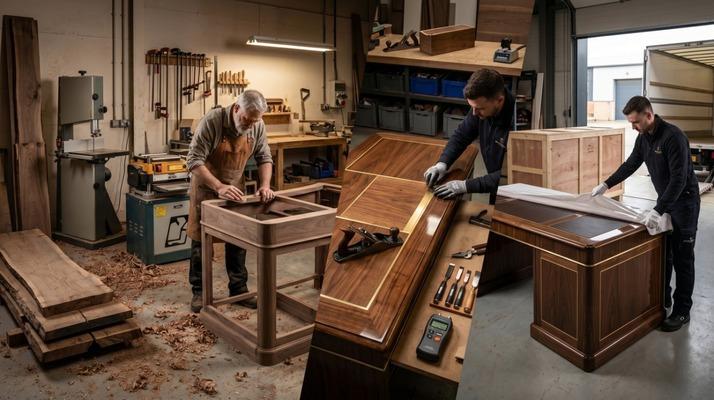
It begins as a stack of raw planks, rough to the touch and smelling of forest rain. Two hundred hours later, that same wood rests inside a corner office, bathed in soft morning light, holding a leather‑bound notebook and a cup of single‑origin coffee. The transformation is not magic. It is methodical, obsessive, and deeply human.At Luxury Group International (LGI), every luxury office desk tells a story long before it meets its owner. This is the story of one such desk—our signature executive model—tracked from the sawmill floor to the final white‑glove salute at your doorstep. Along the way, you will see why a true luxury executive office desk cannot be rushed, and why the hands that build it matter as much as the wood itself.
The First Cut: Selecting Timber That Speaks
Every journey begins with a single log. But not every log earns its place in our workshop. We source only fully mature North American walnut, European white oak, and sustainably harvested mahogany. Each board is inspected for grain continuity, mineral streaks, and natural figure. Knots are not flaws here; they are signatures.
For this particular luxury executive desks project, the client requested a bookmatched walnut top—two adjoining slabs sliced from the same log and opened like a butterfly’s wings. The match must be perfect. If the grain patterns misalign by even two millimeters, the slab is rejected and repurposed for smaller pieces.
Once selected, the timber enters our climate‑controlled acclimation room for six weeks. Wood moves. It breathes. Forcing it into production too early means cracks, warps, or finish failures years later. Patience is not a virtue here; it is a non‑negotiable rule.
From Digital Blueprint to Physical Sculpture
With the wood stable, our design team translates the client’s brief into a full‑scale CAD model. But unlike mass‑produced Luxury Desks, this drawing is only a guide. The real decisions happen at the bench.
We begin with CNC machining for precision—cutting the desk’s main profile, boring holes for integrated wireless charging modules, and carving the hidden cable channels that keep the work surface pristine. A CNC router can hold tolerances of 0.1mm, which is essential for the mechanical lift mechanism on our sit‑stand executive models.
Yet a machine cannot feel grain direction. It cannot slow down when it senses a delicate burl. That is why every desk then moves to our hand‑finishing team. They spend thirty hours with cabinet scrapers and #220‑grit paper, moving with the wood’s natural rhythm. The goal is a surface that feels like silk—not sanded flat, but polished alive.
The Leather Inlay: Where Tactile Luxury Begins
The defining feature of this luxury executive office desk is its recessed leather writing surface. Many brands glue a pre‑cut leather pad into a routed cavity. We do not.
Our leather comes from a family‑owned tannery in Tuscany that has been producing full‑grain hides since 1968. Each hide is hand‑selected for consistency and then skived—thinned gradually from 3mm at the edges to 1.2mm in the center—so that it sits flush with the surrounding wood.
The inlay process is unforgiving. First, we chisel a 5mm deep mortise into the walnut top, cleaning every corner by hand. Then we apply a moisture‑activated adhesive, lay the leather, and use a weighted brass roller to eliminate air pockets. Any bubble means starting over with a fresh piece of hide. No exceptions.
Finally, the edges are burnished with a heated bone folder, creating a seamless transition from wood to leather. Run your finger across the surface. You will feel no lip, no ridge—only the warm contrast of two natural materials becoming one.
Final Quality Control: The White Glove Inspection
Before any desk leaves our workshop, it enters a dedicated inspection room lit by 5000K LEDs—merciless light that reveals every scratch, uneven finish, or misaligned drawer slide. We call it the "Confession Booth" because nothing escapes.
Our lead craftsman, Marco, has forty years of cabinetmaking experience. He runs a gloved hand over every inch of the desk. He opens and closes each drawer exactly twelve times, listening for the perfect damped click of the soft‑close mechanism. He checks the level of the leather inlay with a 0.02mm feeler gauge. He even tests how a glass of water sits on the surface—if it wobbles, the desk fails.
This particular luxury office desk passed on the second attempt. The first try had a micro‑scratch near the left rear leg, invisible to most eyes but not to Marco’s. He rejected it, and the finishing team sanded and re‑oiled the entire surface. That added another ten hours to the journey. Worth every minute.
White Glove Delivery: The Final Handoff
The desk is crated in a custom‑built plywood box, lined with closed‑cell foam and silica gel packets to manage humidity during transit. We do not use shipping carriers who toss boxes onto conveyor belts. Instead, our white‑glove partners are trained to treat each crate like a hospital patient—lifted, never dragged, and opened only in the final room.
On delivery day, two uniformed technicians arrive within a two‑hour window. They uncrate the desk, carry it to your specified location, and level the feet on your flooring. They install any handle or grommet you requested. They even remove the packaging debris. You sign the paperwork only when you are completely satisfied.
For one client in London, the delivery team discovered that the elevator was six inches narrower than expected. They did not force the desk. Instead, they uncrated it in the lobby, padded the corners with felt blankets, and carefully walked the desk up three flights of stairs. That is white‑glove service. That is the end of the 200‑hour journey.
Why Two Hundred Hours Matters
You can buy a decent desk at a big‑box store for three hundred dollars. It will arrive in a flat box, require an Allen key, and last perhaps five years. But a luxury executive desks piece from our workshop is not furniture—it is a tool for your legacy. It will outlive you. It will be repaired, refinished, and passed down.
The 200 hours are not a marketing gimmick. They are the minimum required to select wood that sings, to cut leather that lies flush, and to reject a desk over a scratch that only a master would see. That level of care creates something rare in today’s disposable world: an object worthy of your ambition.
Your corner office is waiting. Let us build the desk that belongs there.
RECENT POSTS
-

The Art of Hospitality on Wheels: How Luxury Trolleys Elevate Boutique Hotel Experiences
September 25, 2026
-

The Art of Grandeur: How Baroque Coffee Tables Transform Luxury Living Spaces
September 25, 2026
-

The Art of Entertaining: How Luxury Bar Furniture Transforms Sophisticated Interiors
September 24, 2026
-
The New Art of Rest: Curating a Wellness-Focused Luxury Bedroom
September 24, 2026
-

Framed Prints That Bring Effortless European Elegance to Apartment Interiors
September 23, 2026
-

How Crystal Chandelier Lighting Transforms Light, Height and Luxury Interiors
September 23, 2026
-

Sculptural Illumination: How Contemporary Floor Lamps Are Becoming Modern Art Statements
September 22, 2026
-

The Art of Choosing a Luxury Table Clock: A Guide to Size, Style & Placement
September 21, 2026
-

Elegant Wall Lamps: The Secret to Warmer, More Characterful Luxury Interiors
September 21, 2026
-

Pairing Luxury TV Units with Living Room Furniture: Create Cohesive Elegance in Modern Homes & Hotel
September 20, 2026