





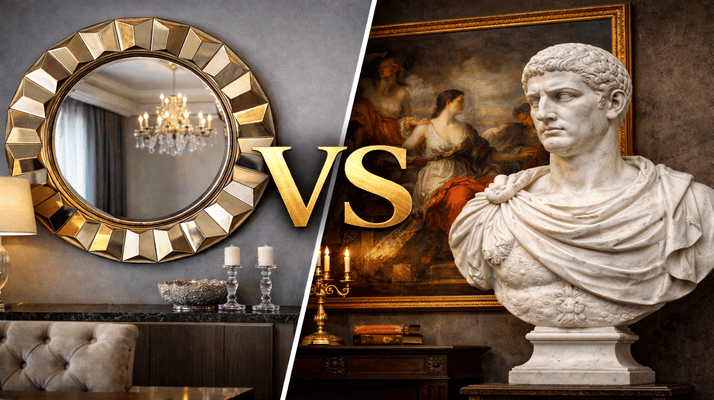
Mirrors vs. Artwork: When to Choose One Over the Other in Home Decor
Posted by Luxury Group International Design Team / Luxury Home Accessories / March 02, 2026
Every well-designed room has a focal point. It is the element that captures attention first and anchors the entire composition. In contemporary luxury home decor, that focal point often comes down to two powerful contenders: decorative mirrors or artwork.Minimalists frequently lean toward mirrors for their functionality and clean elegance. Maximalists often argue that artwork expresses personality in a way no reflective surface can. So when should you choose one over the other? The answer depends on space, mood, purpose, and personal identity.
Let’s explore how decorative mirrors and art each shape interiors—and when one may outperform the other.
The Case for Decorative Mirrors in Luxury Home Decor
Mirrors are more than reflective surfaces. In high-end interiors, decorative mirrors function as architectural tools. They manipulate light, enhance depth, and visually expand rooms.
Mirrors as Space Enhancers
If your room feels compact or lacks natural light, luxury mirrors provide immediate transformation. A large, strategically placed mirror reflects daylight and creates the illusion of openness. This quality makes mirrors particularly effective in urban apartments or narrow hallways.
In minimalist interiors, luxury mirrors maintain visual clarity. Their reflective surface adds dimension without introducing visual clutter. Unlike artwork, which demands interpretation, mirrors blend seamlessly into almost any aesthetic.
Mirrors as Multifunctional Decor
From a design perspective, this multifunctionality gives decorative mirrors an advantage. They contribute to ambiance during the day and enhance artificial lighting at night.
For those who prioritize subtle elegance within luxury home decor, mirrors deliver sophistication without overwhelming the space.
The Emotional Power of Artwork and Sculpture
Artwork, on the other hand, tells a story. While mirrors reflect, art expresses. A painting or sculptural piece invites conversation and reveals personal taste.
Art as Identity
A bold canvas or a thoughtfully placed classic sculpture transforms a wall into a narrative. In maximalist interiors, art becomes layered, textured, and expressive. It defines the mood of a space.
A classic statue placed near a console or within a niche introduces heritage and gravitas. Sculptural art adds depth in a way mirrors cannot replicate. It becomes a focal point that commands attention.
Artwork also carries emotional resonance. Guests may admire a mirror’s frame, but they connect with art on a deeper level.
Artwork and Spatial Anchoring
Unlike mirrors, which expand space visually, art grounds it. A dramatic painting above a sofa stabilizes the room composition. Sculptural elements anchor corners or define transitional areas.
In rooms where lighting and proportions are already balanced, art often becomes the more powerful statement.
Mirrors vs. Artwork: Which Works Best in Each Room?
The choice between decorative mirrors and artwork depends largely on context.
In living rooms with limited light, luxury mirrors amplify brightness and create depth. In spacious living areas with strong architectural features, art often adds character.
In dining rooms, mirrors can reflect chandeliers and enhance ambiance. Meanwhile, a curated piece of art above a sideboard adds individuality.
Bedrooms benefit from both approaches. A mirror introduces practicality, while artwork softens the atmosphere.
In entryways, decorative mirrors are frequently preferred for their functionality. However, a classic statue near the doorway introduces drama and timeless elegance.
Ultimately, the decision depends on whether you want to reflect the room or define it.
Minimalist vs. Maximalist: A Design Debate
The debate between mirrors and artwork often aligns with broader design philosophies.
Minimalist interiors prioritize openness, light, and simplicity. In such settings, luxury mirrors enhance the environment without overpowering it. Their reflective nature keeps walls from feeling heavy.
Maximalist interiors celebrate color, texture, and storytelling. Artwork, classic sculptures, and layered decor elements thrive in these spaces. A classic statue or expressive canvas reinforces personality.
Yet the most compelling interiors often blend both. A decorative mirror above a console paired with sculptural art nearby creates visual balance.
Design is rarely about choosing one extreme.
Pros and Considerations at a Glance
Mirrors enhance space and light while remaining versatile. They complement nearly every style and function practically.
Artwork delivers personality and emotional impact. It establishes clear focal points and encourages conversation.
Mirrors are ideal when you need to visually enlarge a room. Art is better when you want to define mood and identity.
In luxury home decor, the strongest designs understand when to use each element strategically.
The Multifunctional Edge of Luxury Mirrors
If forced to choose, mirrors often hold the multifunctional advantage. They brighten, expand, and decorate simultaneously.
However, mirrors lack narrative. They depend on surrounding elements to create meaning. Artwork and classic sculptures provide that narrative independently.
This is why many designers treat mirrors as enhancers and art as storytellers.
Final Thoughts: Reflect or Express?
Choosing between decorative mirrors and artwork is not about superiority. It is about intention.
If your goal is to increase light, create spatial illusion, and maintain subtle elegance, luxury mirrors offer a practical yet refined solution. If you want to express personality, heritage, or artistic passion, artwork and classic statues provide depth and character.
The most compelling interiors often integrate both, balancing reflection with expression.
Mirror or art in your living room—what would you choose? Cast your vote and join the ongoing design conversation.
RECENT POSTS
-

The Art of Hospitality on Wheels: How Luxury Trolleys Elevate Boutique Hotel Experiences
September 25, 2026
-
The Art of Grandeur: How Baroque Coffee Tables Transform Luxury Living Spaces
September 25, 2026
-
The Art of Entertaining: How Luxury Bar Furniture Transforms Sophisticated Interiors
September 24, 2026
-
The New Art of Rest: Curating a Wellness-Focused Luxury Bedroom
September 24, 2026
-
Framed Prints That Bring Effortless European Elegance to Apartment Interiors
September 23, 2026
-

How Crystal Chandelier Lighting Transforms Light, Height and Luxury Interiors
September 23, 2026
-
Sculptural Illumination: How Contemporary Floor Lamps Are Becoming Modern Art Statements
September 22, 2026
-
The Art of Choosing a Luxury Table Clock: A Guide to Size, Style & Placement
September 21, 2026
-
Elegant Wall Lamps: The Secret to Warmer, More Characterful Luxury Interiors
September 21, 2026
-
Pairing Luxury TV Units with Living Room Furniture: Create Cohesive Elegance in Modern Homes & Hotel
September 20, 2026