





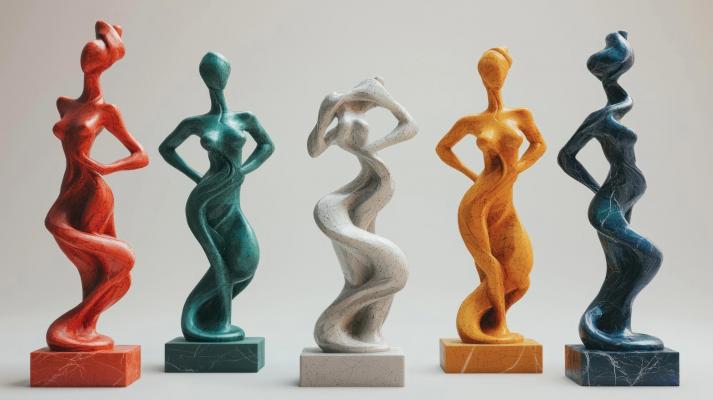
What Defines Modern Sculptures Today? From Abstract Forms to Contemporary Icons
Posted by Luxury Group International Design Team / Luxury Sculptures / January 17, 2026
Quick answer: Modern sculpture is defined less by how it looks and more by how it thinks. It prioritizes concept over realism, uses non-traditional materials like resin, polished metal, and mixed media alongside stone and bronze, and treats form as a spatial statement rather than a purely decorative one. A piece can be figurative and still be modern if it challenges convention or reframes a familiar shape.
Walk into a contemporary gallery — or a well-composed luxury interior — and you'll find modern sculptures that resist easy categorization. Some are abstract and minimal. Others are bold and symbolic. A few sit right on the line between design object and fine art. That range raises a fair question: what actually defines modern sculpture today?
Classical sculpture had rules. Proportion, likeness, and tradition set the standard, and skill was measured by how closely a figure matched reality. Modern sculpture doesn't work that way. It moves with culture, material science, and the sculptor's own point of view, which is exactly why the definition keeps shifting and keeps sparking debate among collectors and designers.
Key takeaways
- Modern sculpture favors interpretation over representation — meaning is built by the viewer, not dictated by the artist.
- Material innovation (resin, alloys, mixed media) is now as central to the definition as form is.
- Placement has changed: sculpture is increasingly a spatial anchor in a room, not a museum-only object.
- "Modern" is arguably a mindset (concept, relevance, reinterpretation) more than a fixed visual style.
From Representation to Interpretation
Historical sculpture was built to represent — gods, rulers, idealized human bodies — and its value was tied to precision and realism. Modern sculpture broke from that. The question shifted from "how accurately does this resemble reality?" to "what does this form express?"
That shift opened the door to abstraction and symbolism. A curve can suggest movement. A fragmented form can suggest tension. Negative space can carry as much weight as solid material. In modern contemporary sculpture, meaning is rarely handed to the viewer — it's built by them.
Form: Reduction With Intent
One of the clearest markers of modern sculpture is deliberate reduction. Clean lines, geometric shapes, and minimal detailing aren't shortcuts — they're a discipline. Stripping away excess forces a focus on balance, rhythm, and proportion, and that restraint is what lets a piece hold its own in a modern interior without competing with the room around it.
In luxury homes and architectural spaces specifically, sculpture has stopped being a decorative afterthought. It's become a spatial anchor — something that directs the eye, defines a zone, and adds quiet drama without dominating the space.
Materials That Redefine the Boundaries
Stone and bronze haven't gone anywhere, but they're no longer the whole story. Modern sculpture increasingly draws on:
- Polished metals and industrial alloys
- Resin and fiberglass
- Mixed-media combinations
- Traditional materials given contemporary finishes
Material choice today is conceptual, not just technical. A reflective surface interacts with light and movement in a way stone can't. A raw texture can deliberately contrast with a refined interior. That freedom is a large part of why modern sculpture feels current rather than academic — see how it plays out in outdoor settings in our piece on luxury garden and courtyard statuary.
From Gallery Pieces to Interior Icons
Sculpture has moved out of the museum and into daily life, particularly in luxury interiors. Designers and collectors now use sculptural pieces as:
- Statement pieces for living rooms
- Focal points in entryways
- Artistic counterpoints to modern furniture and architecture
That functional role doesn't cheapen the art — if anything, it reinforces the point. Modern sculpture is meant to be lived with, not just viewed from behind a rope. Its job is atmospheric as much as visual.
The Role of Concept and Narrative
Where classical sculpture told a clear story, modern work often carries layered or intentionally ambiguous meaning. It might reflect a cultural shift, explore identity or technology, or simply resist a single reading altogether.
That ambiguity is a feature, not a gap. Two people can look at the same piece and walk away with different interpretations, and both can be right. Rather than answering a question, modern sculpture tends to ask one — which is what keeps people looking longer than they expected to.
Is "Modern" a Style or a Mindset?
There's a real debate here. One camp argues modern sculpture is defined by:
- Innovation over tradition
- Concept over ornamentation
- Relevance to contemporary life
Under that framework, "modern" isn't about appearance at all — it's about approach. A figurative piece can still be modern if it challenges convention or reframes something familiar in an unexpected way. That's also why the category keeps feeling dynamic instead of settling into a fixed look.
Why Modern Sculpture Resonates Now
In a fast-moving environment, restrained, thoughtful sculptural forms offer a rare moment of stillness. They align with values people are actively looking for — clarity, intention, authenticity — which is part of why demand for sculptural statement pieces in home design has held up even as trends elsewhere move quickly.
Modern sculpture resonates because it mirrors modern life itself: layered, complex, open to more than one reading. Abstract or iconic, it connects on an emotional level without needing to explain itself.
Frequently Asked Questions
What's the main difference between modern and classical sculpture?
Classical sculpture prioritizes realism, proportion, and tradition. Modern sculpture prioritizes concept, abstraction, and personal interpretation — form serves an idea rather than a likeness.
What materials are used in modern sculpture?
Alongside traditional stone and bronze, modern sculptors work with polished metals, industrial alloys, resin, fiberglass, and mixed media, often chosen for how they interact with light or contrast with an interior.
Can a figurative sculpture still be considered modern?
Yes. If a piece reinterprets a familiar form or challenges convention conceptually, it can be figurative and still fall under the modern category — the mindset behind it matters as much as the shape.
Where does modern sculpture work best in a home?
Common placements include living room focal points, entryways, and as counterpoints to modern furniture — anywhere the piece can act as a spatial anchor rather than competing with surrounding décor.
Defining the Modern Is an Ongoing Conversation
So, what defines modern sculpture today? There's no single answer. It's found in the evolution of form, material, purpose, and perception — a willingness to question tradition, embrace new materials, and leave room for the viewer's own read on the piece.
Maybe that's the most modern thing about it: the definition is never really finished.
What does "modern" mean to you — abstraction, innovation, or emotional connection? The conversation stays open, and that's exactly what keeps the category alive.
RECENT POSTS
-
The Art of Hospitality on Wheels: How Luxury Trolleys Elevate Boutique Hotel Experiences
September 25, 2026
-
The Art of Grandeur: How Baroque Coffee Tables Transform Luxury Living Spaces
September 25, 2026
-
The Art of Entertaining: How Luxury Bar Furniture Transforms Sophisticated Interiors
September 24, 2026
-
The New Art of Rest: Curating a Wellness-Focused Luxury Bedroom
September 24, 2026
-
Framed Prints That Bring Effortless European Elegance to Apartment Interiors
September 23, 2026
-

How Crystal Chandelier Lighting Transforms Light, Height and Luxury Interiors
September 23, 2026
-
Sculptural Illumination: How Contemporary Floor Lamps Are Becoming Modern Art Statements
September 22, 2026
-
The Art of Choosing a Luxury Table Clock: A Guide to Size, Style & Placement
September 21, 2026
-
Elegant Wall Lamps: The Secret to Warmer, More Characterful Luxury Interiors
September 21, 2026
-
Pairing Luxury TV Units with Living Room Furniture: Create Cohesive Elegance in Modern Homes & Hotel
September 20, 2026