





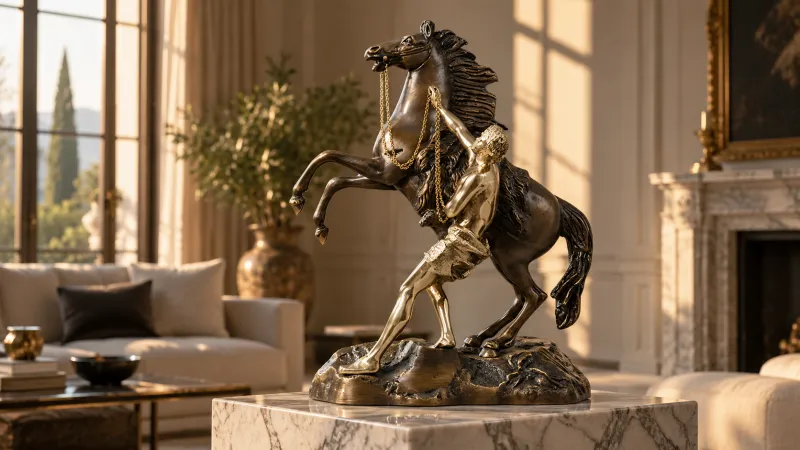
What Makes Handcrafted Bronze Luxury Pieces Worth Every Penny — And How to Spot a Genuine One
Posted by Alessandro Conti / Luxury Home Decor / September 05, 2026
A complete guide for discerning buyers who refuse to settle for anything less than authentic artistry.
The Weight of Authenticity: Why Bronze Luxury Pieces Command Their Price
When you run your fingers across the cool, textured surface of a handcrafted bronze sculpture, you're not just touching metal — you're connecting with centuries of human tradition. Bronze has been humanity's medium of choice for immortalizing beauty since 2500 BC, and today, bronze luxury pieces remain the gold standard for collectors and interior designers who understand that true luxury is never mass-produced.
But here's the honest truth: not everything labeled "bronze" deserves a place in your curated space. The market is flooded with cheap imitations — resin casts with bronze paint, low-quality alloys, and factory-stamped "art" that lacks soul. If you're here, you're already doing what smart buyers do: researching before you invest. Let's walk through what separates museum-worthy luxury bronze sculpture from decorative filler.
The Anatomy of Value: What You're Really Paying For
1. The Lost-Wax Casting Process: Artistry in Every Stage
Genuine handcrafted bronze pieces are born through the ancient lost-wax (cire perdue) casting method — a labor-intensive process that can take weeks or even months for a single piece.
Here's what that journey looks like:
- Sculpting the Original: The artist hand-models the piece in clay, wax, or another pliable material. Every fingerprint, every deliberate imperfection, becomes part of the final work.
- Creating the Mold: A negative mold is made from the original, often in multiple sections for complex forms.
- Wax Replication: Molten wax is poured into the mold to create a hollow wax copy.
- Investment & Burnout: The wax model is encased in a ceramic shell, then heated until the wax melts away — hence "lost wax" — leaving a perfect negative cavity.
- Bronze Pouring: Molten bronze (typically 95% copper with tin and trace elements) is poured into the heated ceramic shell at temperatures exceeding 2,000°F.
- Chasing & Patination: Once cooled, the shell is broken away. The artist then "chases" the metal — hand-finishing seams, refining details, and applying chemical patinas that react with the bronze surface to create rich, living color.
Compare this to a factory process where resin is injected into a mold, spray-painted, and boxed for shipping in under an hour. The difference isn't just aesthetic — it's existential.
2. Material Integrity: Not All Bronze Is Created Equal
Authentic bronze luxury pieces use high-quality bronze alloy. Here's what to look for:
Genuine Bronze:
• Weight: Heavy, substantial feel
• Temperature: Cool to the touch, warms slowly
• Sound: Rings clearly when tapped
• Surface: Slight texture, visible casting marks, organic patina
• Edge Details: Sharp, hand-finished details
Cheap Imitation:
• Weight: Light, hollow, or plastic-like
• Temperature: Room temperature or feels "dead"
• Sound: Dull thud
• Surface: Overly smooth, uniform paint layer
• Edge Details: Soft, blurred edges from mold wear
High-end foundries often use silicon bronze or statuary bronze — alloys specifically formulated for fine art casting. These materials develop a natural patina over decades, actually improving in character rather than deteriorating.
3. The Artist's Hand: Why Signatures Matter
In the world of luxury bronze sculpture, provenance is everything. A genuine piece should come with:
- The artist's signature — often found on the base, incised into the metal itself, not stamped or printed
- Foundry marks — indicating where the piece was cast
- Edition numbers — for limited series (e.g., "3/25"), showing this is one of only 25 ever made
- Certificate of Authenticity — documenting materials, process, and origin
Be wary of "bronze-finish" or "bronze-tone" language — these are red flags that you're looking at painted resin or pot metal, not true bronze.
The Investment Angle: Bronze That Appreciates
Here's something most decor blogs won't tell you: the right bronze luxury pieces can appreciate significantly in value. Unlike mass-market decor that depreciates the moment it leaves the store, limited-edition bronze sculptures from established artists have a track record of strong secondary market performance.
Why? Because bronze is finite. Once an edition sells out, the molds are typically destroyed per foundry tradition. Supply becomes permanently fixed while demand grows as the artist's reputation develops. A piece purchased for $5,000 today could command $15,000 or more in a decade — while simultaneously enriching your daily environment.
This isn't speculation; it's the same principle that governs fine art markets. The key is buying genuine, documented work from the outset.
How to Spot a Genuine Bronze Piece: A Buyer's Checklist
Whether you're shopping at a gallery, auction, or reputable online dealer, run through this checklist before committing:
Visual Inspection
- Look for a living surface. Genuine bronze has subtle variations in color and texture. Machine-made pieces look unnaturally uniform.
- Check the base. Hand-finished bronze bases show tool marks and slight asymmetries. Machine-cast bases are too perfect.
- Examine the patina. Natural patina has depth and variation. Fake patina (paint) looks flat and may chip.
Physical Tests (Where Permitted)
- The magnet test. Bronze is non-magnetic. If a magnet sticks, you're dealing with iron or steel with a bronze coating.
- The weight test. Pick it up. Real bronze is surprisingly heavy for its size. If it feels light, it's likely hollow resin or a light alloy.
- The temperature test. Press your palm against the surface. Bronze will feel distinctly cool and take time to warm.
Documentation Verification
- Request the Certificate of Authenticity. Legitimate sellers of luxury bronze sculpture will have this ready.
- Verify edition numbers. Call the foundry or artist's studio to confirm the edition exists.
- Research the artist. Established bronze artists have exhibition histories, gallery representation, and documented sales records.
Red Flags to Walk Away From
- Prices that seem too good for the claimed size and complexity
- "Bronze-plated," "bronze-finish," or "cold-cast bronze" terminology
- No provenance or artist information available
- Perfect symmetry and zero surface variation
- Seller pressure or unwillingness to provide documentation
Curating Bronze in Your Space: Beyond the Purchase
Once you've invested in authentic bronze luxury pieces, placement matters. Bronze thrives in spaces where light can play across its surface — near windows, under gallery lighting, or positioned to catch the shifting daylight. The patina will evolve subtly over years, responding to your home's atmosphere, humidity, and the oils from human touch.
Many collectors rotate their bronze pieces seasonally, allowing different works to take center stage. Unlike trendy decor that demands replacement, bronze sculptures grow into heirlooms — objects that your children will fight over (lovingly) decades from now.
Final Thoughts: The True Cost of Cheap Imitations
There's an old saying in the art world: "Buy the best example you can afford, even if it means buying less." This applies perfectly to luxury bronze sculpture. One genuine, handcrafted bronze piece will outlast and outperform a houseful of disposable decor.
The upfront investment in authentic bronze pays dividends in daily aesthetic pleasure, conversation-starting presence, and potential financial appreciation. More importantly, it connects you to a lineage of human creativity that stretches back to the ancient Egyptians — a lineage that mass production can never replicate.
So take your time. Ask questions. Demand documentation. Run the tests. The right piece is out there, waiting to become part of your story.
Ready to start your search? Focus on established galleries, artist-direct studios, and auction houses with fine art departments. And remember: in the world of bronze luxury pieces, patience isn't just a virtue — it's a strategy.
Note:- Shop exclusive collections anytime with the luxury furniture app from Luxury Group International.
RECENT POSTS
-
What Makes Handcrafted Bronze Luxury Pieces Worth Every Penny — And How to Spot a Genuine One
September 05, 2026
-

Baroque Lighting Meets Modern Design: Which Style Creates the More Luxurious Interior?
September 05, 2026
-

The Quiet Luxury of Side Tables: How Small Details Transform Sophisticated Interiors
September 04, 2026
-

Royal Beds That Turn Everyday Bedrooms into Palatial Retreats
September 04, 2026
-
12 Versace Wallpaper Designs to Watch in 2026: The Luxury Interiors Everyone Will Be Talking About
September 03, 2026
-
7 Hotel Bed Design Trends Defining Luxury Hospitality in 2026
September 03, 2026
-
The Ultimate Guide to King Size Hotel Beds: Creating 5-Star Comfort Through Luxury Design
September 02, 2026
-
Stainless Steel or Chrome-Plated Bathroom Fittings: The Durability Test Behind Luxury Hospitality
September 02, 2026
-
The Guest Room in 2035: Reimagining Luxury Through Concept Hotels and Future Design
September 01, 2026
-

Modern Bar Stools: The New Signature of Contemporary Luxury Living
September 01, 2026