






Where Should a Mirror Go? The Art of Reflecting Natural Light Without Losing the View
Posted by Elena Voss / Luxury Home Accessories / October 26, 2026
A mirror can make a room brighter.
But that is only half the story.
Placed correctly, it can pull daylight deeper into a space, extend a beautiful architectural sightline and make a compact room feel remarkably open. Placed carelessly, the same mirror can reflect a television, a blank wall, an untidy corner or a harsh patch of sunlight directly into someone's eyes.
The difference is rarely the mirror itself.
It is where the mirror is looking.
For refined European interiors, where natural light, architectural proportions and carefully framed views are often central to the design, mirror placement becomes less of a decorating decision and more of an exercise in spatial composition.
The Window Is Not Always the Answer
When homeowners search for the best mirror placement to reflect natural light, the obvious solution is often to place a mirror directly opposite a window.
Sometimes that works beautifully.
Sometimes it creates a problem.
A mirror facing a large window can capture daylight and redistribute it across the room, particularly when positioned on a wall that would otherwise remain visually dark. But the reflection may also become excessively bright, especially when the window receives strong afternoon or southern exposure.
The better question is not simply, “Where is the window?”
It is:
“What does the mirror see from where it is placed?”
That single question can transform the way a room is designed.
Think in Sightlines, Not Walls
Before deciding where to place a mirror, stand at the main entrance of the room.
Then move toward the seating area.
Look at the room from the position where guests are most likely to sit, walk or pause.
A mirror becomes far more effective when it reflects something worth seeing.
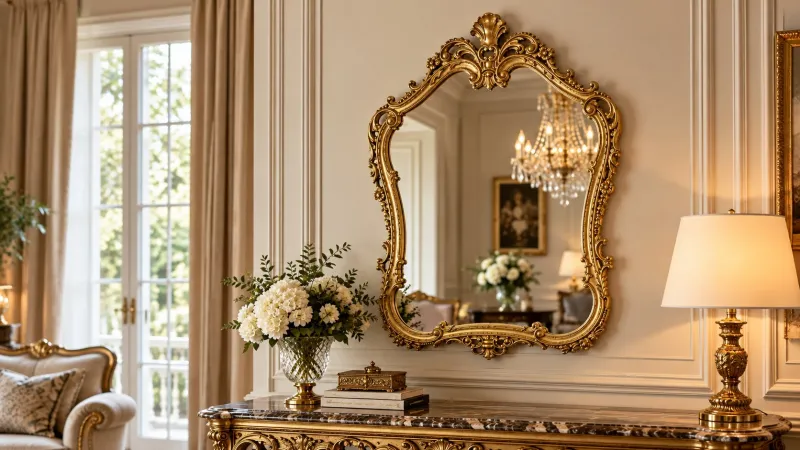
Perhaps it captures a garden through a distant window. Perhaps it doubles the visual presence of an elegant chandelier. It might frame a sculptural console, a piece of artwork or an architectural detail that deserves greater attention.
This is where luxury mirrors become particularly powerful.
A premium mirror is not simply a reflective surface attached to a wall. Its frame, scale, silhouette and placement can become part of the architectural composition.
The reflection should feel intentional.
Almost as though the room has another window.
The Indirect Reflection Trick
There is another approach that often produces a softer result than placing a mirror directly opposite a window.
Instead of facing the mirror toward the window, angle it so that it catches daylight from the side.
This creates an indirect reflection.
The light enters the mirror, travels across the room and creates a more diffused sense of brightness without producing an intense glare. It can be particularly effective in living rooms where direct window reflections would feel too strong.
Imagine a tall mirror positioned perpendicular to a generous French window. Rather than reflecting the glass itself, it can capture the light entering from the window and spread that brightness across a darker wall.
The result feels less like a lighting trick and more like natural illumination.
The Most Important Question: What Will Be Reflected?
This is where many mirror installations go wrong.
A mirror may be beautifully designed, perfectly proportioned and made from exceptional materials — yet still weaken a room if it reflects the wrong subject.
A beautiful view deserves to be repeated.
A cluttered corner does not.
Before installing a mirror, look carefully at its future reflection. Check what appears at eye level, what appears behind seating and what becomes visible when someone enters the room.
In a sophisticated interior, this small exercise can make an enormous difference.
A mirror should ideally amplify the room's strongest features rather than expose its weakest ones.
When More Light Becomes Too Much Light
Natural light is valuable, but more reflection does not always mean better lighting.
A large mirror receiving direct sunlight can create glare on polished floors, glass tables or glossy furniture. In rooms with large south- or west-facing windows, this can become particularly noticeable during certain hours.
The solution may be as simple as changing the angle.
Instead of positioning the mirror to catch the sun directly, shift it slightly so that it receives ambient daylight. You retain the brightness while reducing the sharpness of the reflection.
This is especially important when selecting premium modern mirrors for refined homes, where polished surfaces and metallic finishes may already contribute significant visual reflection.
Luxury is often about knowing when to stop.
Scale Changes Everything
A small decorative mirror can add detail.
A large architectural mirror can change the perceived scale of an entire room.
In a spacious European living room, an oversized mirror can help balance a substantial sofa, fireplace or console. In a narrow hallway, a tall vertical mirror can emphasise ceiling height while catching light from an adjoining room.
But scale should always relate to architecture.
A mirror that is too small may appear disconnected. One that is too large can dominate the composition and make the reflection feel visually aggressive.
The most successful placement usually feels integrated rather than added.
The Luxury of Reflection Without Decoration
One of the most interesting qualities of a well-positioned mirror is that it can make a room feel richer without introducing another decorative object.
A mirror reflecting a chandelier effectively doubles the presence of the lighting feature.
A mirror capturing greenery brings nature visually deeper into the room.
A mirror reflecting architectural moulding creates another layer of symmetry.
This is why luxury mirrors can be so effective in premium interiors. They do not necessarily need elaborate ornamentation to create impact. Their power comes from what they allow the room to reveal.
The mirror becomes almost invisible.
The reflection becomes the design.
Where Reflection Can Feel Surprisingly Elegant
Some of the most effective placements are not directly beside the main window at all.
Consider the wall opposite an open doorway. A mirror there can capture daylight from an adjacent room and visually connect two spaces.
Consider a console positioned beneath a decorative wall. A mirror above it can reflect the room's lighting while creating a layered focal point.
Consider a darker corridor leading toward a brighter living space. A carefully positioned mirror can borrow some of that brightness and make the transition feel more open.
These are subtle interventions, but they demonstrate an important principle:
Mirrors do not create light. They relocate the experience of it.
Reflection Should Have a Purpose
The most sophisticated approach to mirror placement for natural light is therefore not about following a universal rule.
It is about understanding the room.
Where does daylight enter?
Where does it disappear?
Which views deserve repetition?
Which surfaces might create glare?
What does a guest see when approaching the mirror?
And perhaps most importantly — what should the room feel like at the moment the mirror catches their attention?
A well-positioned mirror can make a room brighter, deeper and more visually connected. But its greatest achievement may be something quieter.
It can make natural light appear to belong exactly where it is.
And when that happens, the mirror stops feeling like an accessory.
It becomes part of the architecture.
Note:- Discover the ultimate shopping experience with our luxury furniture app — browse handcrafted Baroque pieces, luxury living room collections, and exclusive designs, all from the convenience of your phon
RECENT POSTS
-
Beyond the Ordinary: Luxury Bar Cabinet Designs That Transform Private Entertaining into an Art
November 09, 2026
-
More Than a Dining Table: The Art of Creating a Luxury Dining Room That Commands Attention
November 07, 2026
-
Beyond the Canvas: How Designer Wall Art Transforms Luxury Furniture into a Beautiful Interior Story
November 06, 2026
-
Echoes of Royalty: How Antique-Inspired Furniture Brings Timeless Grandeur into Modern Luxury Homes
November 05, 2026
-
The Luxury Bedroom Secret: How Elegant Bedside Benches Bring Comfort, Balance & Timeless Sophisticat
November 04, 2026
-
Beyond Five-Star Luxury: The Art of Creating Hotel Interiors That Feel Like Architectural Masterpiec
November 03, 2026
-
Reflections of Grandeur: How Statement Ornate Mirrors Are Redefining Luxury Hotel Spaces in 2026
November 03, 2026
-

Beyond the Garden: Luxury Furniture Arrangements That Transform Outdoor Spaces into Elegant Lounges
November 02, 2026
-
The Quiet Art of Luxury: How Bedroom Furniture Becomes a Reflection of Your Personality
November 02, 2026
-

Halloween in Style: Transform Your Home into a Hauntingly Elegant Luxury Retreat
November 01, 2026


