





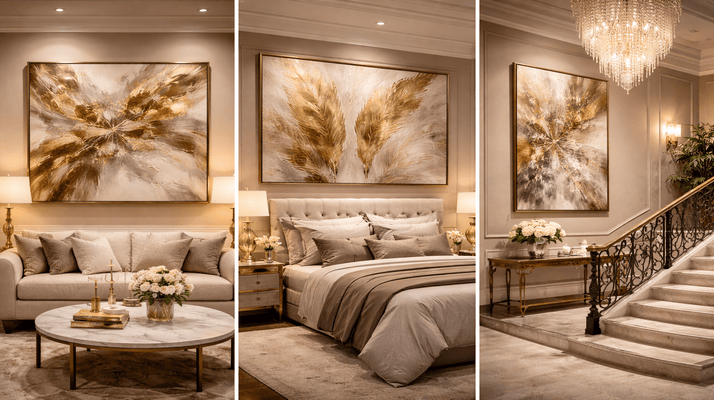
Where to Place Luxury Wall Art for Maximum Visual Impact
Posted by Luxury Group International Design Team / Luxury Wall Decoration / February 17, 2026
Have you ever stepped into a beautifully furnished room and felt something was subtly wrong? The sofa is elegant, the lighting is perfect, yet the artwork feels disconnected. Often, the issue is not the piece itself but its placement. Even the most refined luxury wall art can lose its authority when hung too high, too small, or without proportion.In European villas, luxury hotels, and statement drawing rooms, wall art placement is treated as an architectural decision. Designers calculate scale, spacing, and lighting with precision. If you want interiors that echo this level of sophistication, the placement of your Wall Art Sets matters just as much as the art you select.
Luxury Wall Art Placement in the Living Room: Mastering Scale and Proportion
The living room is the primary stage for visual impact. Designers across Europe rely on proportion rules to ensure balance. The widely accepted two-thirds formula suggests that artwork above a sofa should measure approximately two-thirds the sofa’s width. This creates harmony and prevents the art from appearing visually detached.
Height matters equally. The classical 57–60 inch center rule remains a trusted guideline, even in luxury settings. However, in properties with higher ceilings, designers subtly adapt this measurement while keeping the art visually connected to the furniture below, usually six to ten inches above the sofa.
French modernist designer Jean-Michel Wilmotte once emphasized that “art must converse with architecture, not float above it.” His philosophy reflects a core principle of luxury interiors: artwork should feel anchored, not suspended awkwardly in space.
For expansive rooms, Oversized Luxury Wall Art commands authority and defines the seating area. Alternatively, curated Wall Art Sets introduce rhythm and symmetry. When arranging multi-panel compositions, spacing of two to three inches between panels maintains cohesion without overcrowding.
Do you prefer centered symmetry or artistic asymmetry? In European high-end apartments, symmetry often communicates timeless elegance, while carefully executed asymmetry offers a curated gallery aesthetic.
Dining Room Wall Art: Creating Atmosphere and Conversation
In luxury hotels across Italy and Spain, dining room art is selected and positioned to encourage intimacy and conversation. The width of the artwork typically mirrors the scale of the dining table, often applying the same two-thirds principle used in living rooms.
Because guests are seated, the vertical placement must remain comfortably within eye level. Hanging art too high in a dining room disrupts connection and reduces impact.
Lighting coordination is particularly important here. Adjustable wall washers positioned at a slight angle enhance texture and prevent glare, especially on metallic finishes and detailed framed wall art work. Italian architect and designer Gio Ponti believed that “light is the true interpreter of space.” His insight remains relevant: even the most exquisite piece requires thoughtful illumination to reveal its depth and texture.
Bedroom Art Placement: Balancing Serenity and Presence
Luxury bedrooms prioritize calm sophistication. Art above the bed should measure roughly two-thirds the width of the headboard and sit six to eight inches above it to maintain proportion.
In high-end European residences, designers often choose softer palettes and textured surfaces to maintain serenity. Oversized pieces can create a dramatic focal point, while multi-panel Wall Art Sets bring structure to minimalist interiors.
Spanish surrealist Salvador Dalí once remarked, “A painting is a photograph made by hand.” While his works were bold and unconventional, his statement underscores the personal nature of art. In bedrooms, placement should reflect intimacy and identity, not simply decoration.
Have you ever hung art too high? Most people do. In bedrooms especially, art that sits too close to the ceiling can feel detached and diminish the room’s sense of intimacy.
Hallways and Staircases: Turning Transitional Spaces into Galleries
European villas frequently treat hallways as curated galleries rather than forgotten corridors. The 57–60 inch center guideline remains reliable for consistent viewing height along a passageway. Alignment and spacing must remain precise, as even slight inconsistencies can disrupt visual flow.
Staircases offer a more dynamic opportunity. Instead of rigid horizontal alignment, art can follow the incline of the staircase, echoing architectural movement. German architect Peter Zumthor has often spoken about how “architecture is experienced in movement.” The same principle applies to wall art along staircases; placement should guide the eye naturally upward.
Large vertical Oversized Luxury Wall Art can dominate tall stairwell walls, creating dramatic focal points visible from multiple levels. Lighting here becomes essential, ensuring the art maintains impact from every angle.
The Role of Lighting in Luxury Wall Art Placement
Beyond scale and spacing, lighting defines the final effect. Directional lighting enhances texture, depth, and material quality, especially in premium framed wall art work. Soft ambient lighting creates mood, while accent lighting emphasizes detail.
In European luxury hotels, layered lighting schemes ensure artwork transforms from daytime elegance to evening drama. Reflective surfaces, metallic accents, and textured finishes respond differently depending on illumination, making thoughtful coordination essential.
Conclusion: Precision Defines Luxury
In refined interiors, placement is never accidental. Whether in a Parisian apartment, an Italian villa, or a contemporary penthouse, successful luxury wall art placement depends on proportion, height, spacing, and light.
The two-thirds width rule ensures scale harmony. The adapted 57–60 inch center guideline maintains visual comfort. Multi-panel spacing preserves cohesion. Coordinated lighting enhances texture and drama.
Luxury is measured in details, and often the difference between ordinary and extraordinary lies in just a few inches.
So, what defines your aesthetic—perfect symmetry or curated asymmetry? The answer may shape your entire space.
RECENT POSTS
-

The Art of Hospitality on Wheels: How Luxury Trolleys Elevate Boutique Hotel Experiences
September 25, 2026
-
The Art of Grandeur: How Baroque Coffee Tables Transform Luxury Living Spaces
September 25, 2026
-
The Art of Entertaining: How Luxury Bar Furniture Transforms Sophisticated Interiors
September 24, 2026
-
The New Art of Rest: Curating a Wellness-Focused Luxury Bedroom
September 24, 2026
-
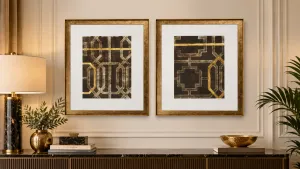
Framed Prints That Bring Effortless European Elegance to Apartment Interiors
September 23, 2026
-
How Crystal Chandelier Lighting Transforms Light, Height and Luxury Interiors
September 23, 2026
-
Sculptural Illumination: How Contemporary Floor Lamps Are Becoming Modern Art Statements
September 22, 2026
-

The Art of Choosing a Luxury Table Clock: A Guide to Size, Style & Placement
September 21, 2026
-
Elegant Wall Lamps: The Secret to Warmer, More Characterful Luxury Interiors
September 21, 2026
-
Pairing Luxury TV Units with Living Room Furniture: Create Cohesive Elegance in Modern Homes & Hotel
September 20, 2026