





Why Bronze Sculptures Remain the Timeless Choice for Discerning European Collectors in 2026
Posted by Luxury Group International Design Team / Classic Sculptures / August 09, 2026
Or: How a lump of molten metal became the heartbeat of my living roomI still remember the first time I touched a bronze sculpture that made me cry.
It was 2003. I was 24, fresh out of art history at the Sorbonne, and I had wandered into a small gallery in the Marais that I had no business being in. The owner—a gruff man named Henri who smoked Gauloises and clearly wanted me to leave—ignored me while I circled the room, pretending I belonged there.
And then I saw her.
A small figurative bronze, maybe 30 centimeters tall. A woman caught mid-movement, her body twisted as if she'd just heard someone call her name. The patina was this impossible deep green that seemed to glow from within, like moss on ancient stone. Her face wasn't beautiful in a conventional way. She looked tired. Hopeful. Real.
I reached out—Henri barked something about not touching—and the moment my fingertips brushed that cold, smooth surface, I felt something I couldn't name. Weight. History. The thousands of hours some artist had spent staring at a model, building a wax form, watching it disappear into fire, hoping the bronze would remember what they'd tried to capture.
I couldn't afford her. She was €4,200, which was roughly four months of my rent. I went back three times. On the fourth visit, Henri finally looked at me properly, exhaled a cloud of smoke, and said: "You keep coming back. She is yours for €3,800. But only because you see her."
She still sits on my desk. Twenty-three years later. I've bought and sold dozens of bronzes since then—eagles, horses, abstract forms, a bizarre but magnificent piece of cats in a boat that I found in a Vienna estate sale. But that woman? She taught me everything I needed to know about why bronze endures.
Here's what I've learned since.
The Question I Get Asked Most: "Bronze Animal or Figurative for Your Space?"
I get this email at least twice a week. Someone has a new penthouse in Geneva, or they've finally renovated the country house in Provence, or their gallery in Munich needs a centerpiece. And they always ask the same thing: "What should I get? Something figurative? An animal? Abstract?"
My answer frustrates people: What keeps you awake at night?
Not literally. I mean—what do you keep returning to in your mind? What image, what story, what feeling?
I had a client in 2019, a Swiss pharmaceutical executive with a home in Zürich that looked like an architectural magazine had thrown up on it. Everything was perfect. Cold, expensive, and perfect. He wanted a bronze eagle for his study. "Something powerful," he said. "Something that says I've arrived."
I showed him three eagles. Magnificent pieces, wings spread, talons gripping stone, every feather rendered in impossible detail. He liked them. He didn't feel anything.
Then I showed him a small bronze of a horse's bust on a marble pedestal. Not a stallion rearing in glory. Just a horse, head lowered, eyes half-closed, caught in a moment of rest. The artist had spent six months with a retired racehorse in Normandy, just watching. You could see it in the way the neck muscles relaxed, the way the ears weren't pinned back in alertness but soft, almost dreaming.
My client stood in front of it for ten minutes without speaking. Then he said: "My grandfather had horses. In Tuscany. I used to sit with them in the afternoons when I was small. I had forgotten."
He bought it. Not the eagle. The horse. And every time I visit, he tells me something new he notices about it—the way the light hits the mane at 4 p.m., the tiny imperfection in the left ear where the artist's thumb slipped during the wax stage.
That's the thing about bronze. It doesn't just sit there. It waits. It waits for you to be ready to see something in it that you didn't know you needed.
So my answer to "animal or figurative?" is always: Start with what you can't stop thinking about. The rest is just logistics.
The Alchemy Nobody Talks About
People think bronze is just metal. It's not. It's fire, memory, and patience folded into something you can hold.
I spent a week at a foundry in Pietrasanta, Italy, in 2015. I wanted to understand what I was actually selling to people. The owner, Marco, was third-generation. His grandfather had cast pieces for Henry Moore. His father had worked with Botero. Marco himself had the hands of a stonemason and the eyes of someone who had watched too many things melt.
He showed me the lost-wax process—the same technique used since the ancient Greeks. You build a model in wax. You cover it in plaster. You burn out the wax (hence "lost wax") until you're left with a hollow shell. Then you pour molten bronze—1,200 degrees Celsius—into that empty space and pray.
Pray that the bronze flows into every crevice the artist carved. Pray that no air bubbles form. Pray that the shell doesn't crack under the heat. Pray that when you break away the plaster, what's left is even remotely close to what the artist imagined.
Marco told me something I'll never forget: "Every bronze is a miracle. The metal has a memory of what it was before—the ore, the earth—but it also has a new memory now. The artist's hands. The fire. The moment it cooled. That memory stays in the metal forever. That's why people feel something when they touch it. They're touching a moment that will never happen again."
I thought he was being poetic. Then I watched him cast a small figure of a woman—similar to my first piece, actually—and when the plaster came away, there was a flaw. A tiny crack running through her left shoulder. The artist, a French woman named Claire who had flown in from Lyon, looked at it for a long time. Then she smiled and said: "Good. Now she has a scar. Like me."
They didn't fix it. It's in a private collection in Brussels now. The owner knows about the crack. He says it's his favorite part.
That's bronze in 2026. In an age of 3D printing and AI-generated "art" that can be reproduced infinitely, bronze remains stubbornly, gloriously singular. Each piece carries the fingerprints of its making. The slight unevenness of hand-finished patina. The way gravity pulled the molten metal just slightly differently in this pour versus the last. The moment when the artist decided: this is enough. Stop here.
You cannot fake that. You cannot algorithm it. You cannot mass-produce the soul of a thing.
What European Collectors Are Actually Buying in 2026
I've been tracking the market for two decades, and 2026 feels different. Not because tastes have changed dramatically, but because the reasons people collect have deepened.
The Eagle: Power, But Make It Thoughtful
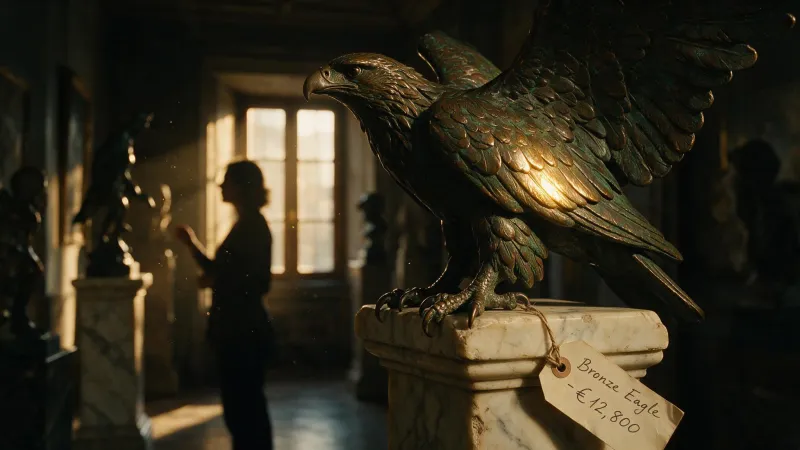
Bronze eagles have always been popular. They symbolize vision, dominance, the sweep of empire. But the eagles I'm seeing move in 2026 are different from the aggressive, talons-out pieces of the 1990s.The ones that sell now are quieter. Wings not spread in attack, but in descent—landing, settling, arriving. There's a stillness to them. Collectors tell me they want "strength without shouting." The eagle on my desk at the gallery right now has its head turned slightly to the side, as if listening to something we can't hear. A German collector bought it last month for his Frankfurt office. He said: "I don't want to intimidate people who walk in. I want them to feel they've entered a space where someone is paying attention."
That's the shift. Power used to be about display. Now it's about presence.
The Female Form: Beyond the Male Gaze
Figurative bronze of women is having a renaissance, but not the way you'd expect. The reclining nudes and idealized Venuses still exist, and they still sell to certain buyers. But the pieces that genuinely excite me—and the ones that fly out of the gallery—are the ones that capture women in motion, in thought, in their own bodies rather than someone else's fantasy.I have a piece right now of a woman mid-stride, one foot barely touching the ground, her coat billowing behind her like a wing. Her face isn't serene or seductive. She's frowning slightly, looking down at something in her hand—a letter, maybe, or a phone. She looks interrupted. She looks busy. She looks like she has somewhere to be and you're in her way.
A Norwegian collector bought her for his wife's study. He told me: "My wife is a judge. She doesn't want to look up from her desk and see a woman waiting to be looked at. She wants to see a woman who has things to do."
That's the conversation in 2026. Bronze isn't just decorative anymore. It's identity. It's statement. It's who you are when nobody's performing.
The Unexpected: Cats in a Boat, and Other Joys
My favorite sale of last year was absurd. A bronze sculpture of three cats in a small rowboat, one standing at the bow like a captain, the other two curled in the stern looking seasick. It was whimsical, detailed, utterly ridiculous, and technically perfect.
A Dutch couple bought it for their canal house in Amsterdam. They have no children. They have two cats. They told me: "We saw it and laughed for five minutes. In a house full of serious art, we needed something that didn't take itself seriously. But it's still beautiful. That's rare."
Yes, they could have bought another abstract form. Yes, they could have invested in something "more significant." But they bought joy. And in 2026, with everything the world has been through, I see more and more collectors making that choice. Bronze doesn't have to be solemn to be timeless. It just has to be true.
The Pedestal Problem (And Why It Matters More Than You Think)
Can I tell you something that drives me insane? Collectors who spend €15,000 on a bronze and then put it on a €200 pedestal from a furniture chain.
I get it. The sculpture is the star. The pedestal is just... there. But here's the thing: the pedestal is the first thing your eye processes before it reaches the bronze. It's the frame. It's the silence before the music.
A bronze horse bust on a cheap wooden pedestal looks like a trophy from a corporate golf tournament. The same bust on a hand-carved marble pedestal with subtle veining? It becomes a conversation with centuries of sculpture tradition.
I work with a stone carver in Carrara who makes pedestals specifically for bronzes. He asks me three questions every time:
- "Where does the light come from in the room?"
- "What is the floor made of?"
- "What is the tallest person who will live with this piece?"
My Carrara carver charges €800–€2,500 for a pedestal. Collectors balk. Then they see the piece installed, and they understand. The pedestal isn't an accessory. It's the stage. And bronze deserves a good stage.
Heritage Storytelling: Why I Tell Every Buyer Where Their Bronze Came From
I have a ritual. When someone buys a bronze from me, I don't just hand them a receipt and a box. I sit with them—sometimes over wine, sometimes just coffee—and I tell them the story.
Not the artist's biography. Not the market value. The making.
I tell them about the foundry. About the wax model that sat in a studio for months while the artist adjusted a finger by half a millimeter. About the day of the pour, when everyone held their breath. About the patina artist who spent a week with acids and heat, building layer upon layer of color until it looked like something that had been buried and resurrected.
I had a young collector from Copenhagen last year, maybe 32, tech money, first serious art purchase. He bought a small abstract bronze, very contemporary, very clean. As I told him the story of its making, he started to tear up. He tried to hide it. I pretended not to notice.
Afterward, he said: "I didn't expect to feel something. I thought I was buying an object. But you just gave me a memory that belongs to me now."
That's heritage storytelling. It's not marketing. It's not sales technique. It's the recognition that when you bring bronze into your home, you're not decorating. You're adopting a history. You're becoming part of a lineage that stretches back to the Greeks, through the Renaissance, through Rodin's tortured hands, through every artist who ever stood in front of a furnace and hoped.
In 2026, with so much of our lives existing in pixels and clouds, there's something radical about owning a thing that was forged. That was risked. That could have failed at a dozen different moments but didn't.
That's what European collectors are paying for now. Not just beauty. Not just status. But weight. The weight of something that exists because human hands and human fire made it so.
A Quick Poll for You
Before I wrap this up, I want to hear from you. I'm genuinely curious.
If you were choosing one bronze for your space right now, would you go:
- Classic — figurative, traditional forms, the eternal human or animal rendered in timeless bronze
- Modern — abstract, contemporary, shapes that suggest rather than describe
Drop your answer in the comments. I'll read every single one, and I'm planning a follow-up post based on what you tell me—diving deeper into whichever direction resonates most. Maybe we'll explore the resurgence of classical training in European ateliers, or the bold new voices redefining what bronze can be in the 21st century.
Your voice shapes what comes next. That's the deal.
My Final Thought (And the Reason I Still Do This)
I'm 47 now. My hands have started to ache in cold weather from years of lifting and moving heavy pieces. I have a small herniated disc from a pedestal that tipped the wrong way in 2018. I spend too much time on planes flying to foundries and estate sales and collectors' homes.
And I still, still, get that feeling when I unwrap a new bronze in my gallery. That catch in the throat. That sense of being in the presence of something that outlives me.
Last month, I sold a bronze eagle to a collector in Vienna. He was 78, a retired conductor, and he wanted it for his study where he still listens to Mahler every morning. As his assistant and I uncrated it together, he stood in the doorway in his slippers, hands clasped behind his back, and he didn't speak for a long time.
Then he said: "My father had a bronze. Smaller than this. A dancer. The Nazis took it in '38. He never stopped talking about it. I think—I think I have been looking for it my whole life. This isn't it. But it feels like the same intention. Do you understand?"
I understood.
That's why bronze remains timeless. Not because it's expensive. Not because it's "luxury." Because it holds memory. Because it outlasts regimes and fashions and trends. Because when everything else in a room is new and temporary, the bronze was already old when it was made—it was born from ore that formed in the earth millions of years ago, shaped by fire, cooled into something that will still be here when we're dust.
Buy the eagle. Buy the horse. Buy the woman caught mid-stride or the cats in the boat or the abstract form that only makes sense when the light hits it at 5:47 on a winter afternoon.
But buy it because you feel something. Because you can't stop thinking about it. Because it makes you remember something you didn't know you'd forgotten.
That's the only reason that matters. Everything else is just logistics.
RECENT POSTS
-
The Art of Entertaining: How Luxury Bar Furniture Transforms Sophisticated Interiors
September 24, 2026
-
The New Art of Rest: Curating a Wellness-Focused Luxury Bedroom
September 24, 2026
-
Framed Prints That Bring Effortless European Elegance to Apartment Interiors
September 23, 2026
-

How Crystal Chandelier Lighting Transforms Light, Height and Luxury Interiors
September 23, 2026
-
The Art of Choosing a Luxury Table Clock: A Guide to Size, Style & Placement
September 21, 2026
-
Elegant Wall Lamps: The Secret to Warmer, More Characterful Luxury Interiors
September 21, 2026
-
Pairing Luxury TV Units with Living Room Furniture: Create Cohesive Elegance in Modern Homes & Hotel
September 20, 2026
-
CEO Office Design: Desk and Executive Chair Ideas for a High-End Corporate Interior
September 20, 2026
-

How to Choose a Living Room Side Table: 5 Design Rules | The Golden Ratio Guide
September 19, 2026
-
Why Boutique Hotels Are Investing in Classic Marble Statues for Lobbies and Gardens
September 19, 2026