





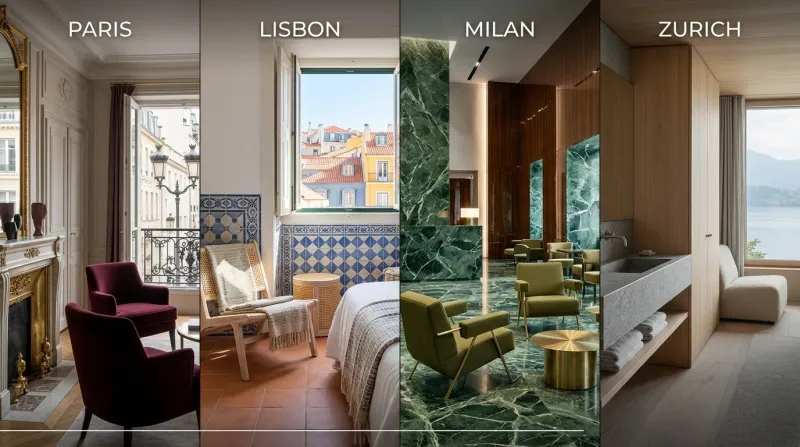
Why the Most Exclusive New Hotels Look Completely Different in Paris, Lisbon, Milan & Zurich
Posted by Luxury Group International Design Team / Luxury Hotel Interior / August 22, 2026
There was a time—not too long ago—when entering a five-star hotel room in Europe felt like stepping into an elevated vacuum of globalized homogeneity. Whether you unlatched your leather luggage in Paris, Milan, or Zurich, you were greeted by the exact same polished beige marble, the same weightless greige wool drapery, and the same mass-manufactured veneer headboards. It was comforting to some, but utterly void of soul.
That era of copy-paste opulence is dead.
Today, the world’s most discerning travelers are demanding authenticity over repetition. The new frontier of hospitality is rooted in hyper-localization—a design philosophy where a property draws its visual, tactile, and spatial DNA directly from the street beneath its foundation. In my work as an interior designer across the continent, I’ve watched this shift transform how hotel design reflects local culture in Europe. When you wake up in a modern boutique sanctuary today, you instantly know where you are through the texture of the plaster, the weight of the hardware, and the specific craftsmanship woven into the bespoke luxury hotel furniture.
Let’s examine how four of Europe’s design capitals are carving out distinct visual identities in response to this cultural movement.
Paris: Haussmannian Drama, Couture Textures & Intimate Boiserie
In the French capital, hospitality design has abandoned the heavy-handed gilding of Louis XIV in favor of something far more sensual: the refined intimacy of a private Haussmannian apartment combined with the precise sartorial detailing of Haute Couture.
Parisian Palette Focus:
├── Base: Creamy chalk plaster & aged chevron parquet
├── Accents: Deep burnt-amber velvet, Pierre Frey mohair, aged brass
└── Details: Custom-embroidered silk trims & restored boiserie
When approaching Paris hotel interiors, the goal is never to build something entirely new; it is to engage in a sophisticated dialogue with history. The newer properties popping up near the Place Vendôme or along the Right Bank are built around spatial romance. Moldings aren't just decorative borders—they frame hand-painted wall panels or textured linen plasterwork.
Materiality and Joinery
French luxury relies heavily on custom joinery (boiserie) painted in soft, chalky whites or rich ebonized tones. Furniture silhouettes lean away from rigid geometric lines, opting instead for curved, enveloping forms. Think velvet-upholstered boudoir chairs with bullion fringe, low-slung lounge seats in deep mustard or forest green mohair, and fluted marble vanity stands reminiscent of 1920s French Art Deco.
In properties like Château Voltaire or Hôtel Madame Rêve, the luxury hotel furniture feels curated over decades by an eccentric art collector rather than specified from a commercial catalog. Nightstands are executed in heavily veined Grand Antique marble, paired with antique brass toggle switches that click with a satisfying mechanical weight. It is an aesthetic built on romance, shadow, and quiet visual tension.
Designer’s Note: To capture authentic Parisian elegance, avoid bright overhead lighting. Parisian interiors rely entirely on indirect, low-level illumination—silk-shaded sconces mounted directly onto timber paneling, parchment floor lamps, and picture lights that illuminate micro-textured plaster.
Lisbon: Sun-Drenched Azulejos, Tactile Terracotta & Artisanal Craft
Fly south to Portugal, and the design dialogue shifts entirely from atmospheric drama to light, materiality, and earth-driven tactile honesty. Lisbon’s hotel landscape has undergone a magnificent renaissance, anchored deeply in regional hotel interior styles that honor the country’s maritime heritage and incredible ceramic tradition.
Lisbon Materiality Spectrum:
[Raw Terracotta Tile] ── [Hand-Glazed Azulejos] ── [Bleached Portuguese Oak] ── [Lioz Limestone]
Where Paris wraps you in thick velvets, Lisbon invites you to touch sun-baked, hand-molded surfaces. The city’s finest new boutique hotels—such as the restored palácios in Chiado and Alfama—reject slick synthetic finishes in favor of materials that celebrate minor imperfections and human touch.
The Craft of Portuguese Hospitality
European luxury hotel design in Portugal centers on natural cooling elements softened by organic warmth. Designers are reinterpreting traditional ceramic azulejos not as quaint blue-and-white postcard motifs, but as massive, monochromatic, hand-glazed feature walls that reflect the Atlantic light.
Key structural elements defining Lisbon luxury include:
- Lioz Limestone: The creamy, fossil-rich stone native to Portugal, used for seamlessly integrated sinks and monolithic bathroom vanities.
- Woven Textiles & Linen: Drape fabrics left unbleached, allowing natural sunlight to filter softly into rooms framed by tall, shuttered balcony windows.
- Tactile Woodworking: Custom headboards carved from local chestnut or bleached Portuguese oak, paired with terracotta floor tiles smoothed by hand.
The furniture in these spaces tends to be low-profile and sculptural. Instead of ornate upholstery, you find solid timber frames, woven cane backs, and matte leather strap details. It feels relaxed, sun-bleached, and intensely rooted in Portuguese soil.
Milan: Mid-Century Rationalism, High-Octane Marble & Architectural Precision
Crossing the Alps into Lombardy, Lisbon's earthiness gives way to Milan’s unyielding commitment to industrial design, architectural grandeur, and high-fashion bravado. Milan luxury hotels do not play at being rustic retreats; they are unapologetically urbane, confident, and meticulously structured.
The Milanese Design Matrix:
├── Architecture: Rationalist geometry & lofty arched colonnades
├── Materials: Polished Verde Alpi marble, brushed bronze, rich lacquer
└── Furnishings: Precision mid-century icons & bespoke Italian joinery
Milanese interior architecture draws heavily on the mid-century masterworks of Gio Ponti, Piero Portaluppi, and Luigi Caccia Dominioni. When you walk into a newly restored Milanese stay—such as the stunning Portrait Milano housed within a 16th-century seminary—you are surrounded by bold geometric rationalism.
Tailored Polish and Graphic Contrast
Furniture specification in Milan operates at the absolute peak of manufacturing precision. Italian luxury hotel furniture is defined by tailored leather stitching, high-gloss walnut boiserie, and heavy metal accents finished in hand-brushed bronzed brass.
Bathrooms are not merely functional quarters; they are dramatic stone sanctuaries clad floor-to-ceiling in intensely figured marbles—Breccia Medicea, Carrara, or deep Verde Alpi. Colors are used with graphic precision: cardinal reds, olive greens, and deep navy tones balanced by warm blonde walnut or dark larch wood floors. It is an environment that feels like a custom-tailored Broni suit—crisp, structured, and strikingly stylish.
Zurich: Alpine Precision, Sculptural Timber & Quiet Luxury
In Switzerland, hospitality design strips away theatrical drama to reveal an absolute masterclass in material purity, acoustic comfort, and quiet craftsmanship. Zurich’s luxury hotels reflect a culture that values understatement, functional longevity, and an uninterrupted connection to the alpine landscape.
Zurich Material Hierarchy:
├── Primary: Brushed local larch & Swiss granite
├── Acoustic Layer: Wool felt, textured bouclé, padded acoustic paneling
└── Finish: Matte black steel & precision-engineered joinery
Swiss luxury does not shout; it hums softly in perfect pitch. The design philosophy behind new luxury stays along Lake Zurich is deeply connected to nature and human wellness. Space planning prioritizes clean visual sightlines, expansive glazing, and immaculate acoustic engineering. You step off a bustling lakefront street into a room where silence feels like a physical luxury.
Architectural Minimalism Meets Alpine Warmth
In Zurich, luxury hotel furniture focuses heavily on form, touch, and ergonomic perfection. Rather than shiny brass or heavy ornamentation, designers specify matte-brushed steel, dark Swiss granite, and deeply tactile brushed larch panelling.
Key characteristics of the Zurich aesthetic:
- Tactile Warmth: Furniture upholstered in thick wool bouclés, cashmere throws, and matte aniline leathers.
- Architectural Integration: Built-in joinery where wardrobes, minibars, and lighting controls are concealed behind flush, seamless timber panels.
- Precision Hardware: Every drawer glides with silent Swiss mechanics, and every switchboard is built with clean, tactile minimalism.
The visual narrative is clean and calm, letting light, natural timber grain, and views of water or mountains take center stage.
Comparative Design Anatomy: Four Capitals at a Glance
To truly understand how these regional hotel interior styles differ, we can break down their core architectural and decorative components side by side:
Paris
Chalk plaster, velvet, chevron oak
Powder blush, burnt amber, sage green
Curved, plush, draped
Soft sconces, low lamp light, romance
Lisbon
Azulejo tiles, Lioz stone, raw linen
Terracotta, cobalt, sand, terracotta
Low-slung, woven timber, relaxed
Diffused sun, natural shadows, warmth
Milan
Verde Alpi marble, lacquered walnut
Cardinal red, olive green, midnight navy
Rationalist, tailored, sharp
Graphic floor lamps, concealed LEDs
Zurich
Brushed larch wood, honed Swiss granite
Slate grey, snow white, oat, dark charcoal
Minimalist, ergonomic, integrated
Architectural, warm recessed, glare-free
Interactive Style Quiz: Which Hyper-Local Luxury Aesthetic Fits Your Design Soul?
Answer these three quick questions to discover which European hospitality style matches your personal aesthetic identity!
1. Choose your ideal morning hotel setting:
- A) Sipping espresso in a velvet armchair beside a tall French window with plaster moldings framing the street view.
- B) Unwinding on a sunlit stone terrace with a cool linen breeze, listening to the ocean and resting your feet on terracotta tiles.
- C) Reading an art journal on a sleek leather sofa surrounded by polished walnut paneling and bold marble coffee tables.
- D) Looking out over a quiet, mirror-like lake from a minimalist timber daybed wrapped in a cashmere throw.
2. What tactile finish makes your heart beat faster?
- A) Deep mohair velvet and hand-carved gilded frames.
- B) Hand-glazed matte ceramics and raw, unbleached linen.
- C) Rich, highly veined green marble and brushed bronze hardware.
- D) Smooth, brushed Swiss larch wood and tactile wool bouclé.
3. Your design philosophy in three words:
- A) Romantic, Historic, Tailored.
- B) Sun-drenched, Organic, Artisanal.
- C) Bold, Architectural, Polished.
- D) Serene, Precise, Understated.
Your Results:
- Mostly A's — Parisian Couture Romantic: You belong in the elegant salons of the Right Bank. Your style favors soft drama, deep textures, and intimate historical references.
- Mostly B's — Iberian Artisanal Soul: You thrive in spaces driven by light, raw materials, and slow craft. You value warmth, texture, and relaxed coastal elegance.
- Mostly C's — Milanese Rationalist: You appreciate high-octane sophistication, architectural structure, and the absolute peak of modern Italian furniture design.
- Mostly D's — Swiss Alpine Minimalist: You seek quiet luxury, precision execution, acoustic peace, and an effortless connection to the natural environment.
The Enduring Value of Authenticity
The rise of hyper-local European luxury hotel design is more than a fleeting hospitality trend—it is a long-overdue celebration of cultural identity. When a hotel honors the master craftspeople, quarry stones, and architectural legacies of its specific city, it stops being merely a place to sleep and becomes a living gallery of local culture.
As designers, our challenge moving forward isn't just creating beautiful rooms. It's ensuring that when a traveler opens their eyes in Paris, Lisbon, Milan, or Zurich, they feel the unmistakable soul of the city instantly speaking back to them.
RECENT POSTS
-
The Art of Entertaining: How Luxury Bar Furniture Transforms Sophisticated Interiors
September 24, 2026
-
The New Art of Rest: Curating a Wellness-Focused Luxury Bedroom
September 24, 2026
-
Framed Prints That Bring Effortless European Elegance to Apartment Interiors
September 23, 2026
-
How Crystal Chandelier Lighting Transforms Light, Height and Luxury Interiors
September 23, 2026
-

The Art of Choosing a Luxury Table Clock: A Guide to Size, Style & Placement
September 21, 2026
-
Elegant Wall Lamps: The Secret to Warmer, More Characterful Luxury Interiors
September 21, 2026
-
Pairing Luxury TV Units with Living Room Furniture: Create Cohesive Elegance in Modern Homes & Hotel
September 20, 2026
-
CEO Office Design: Desk and Executive Chair Ideas for a High-End Corporate Interior
September 20, 2026
-
How to Choose a Living Room Side Table: 5 Design Rules | The Golden Ratio Guide
September 19, 2026
-
Why Boutique Hotels Are Investing in Classic Marble Statues for Lobbies and Gardens
September 19, 2026