





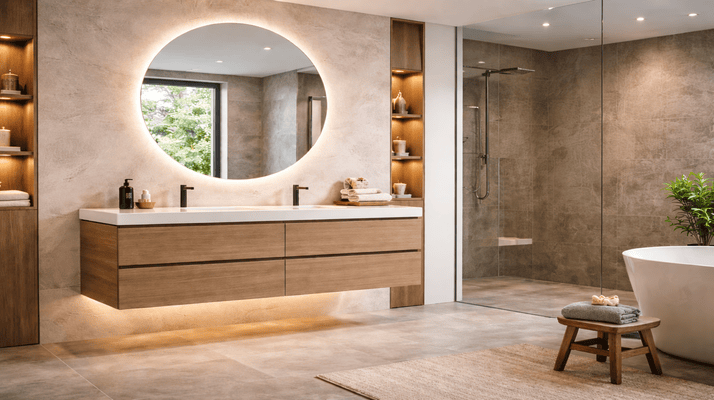
Are Bulky Vanities Outdated? The Rise of Floating Bathroom Cabinets in Modern Design
Posted by Luxury Group International Design Team / Luxury Bathroom Furniture / April 19, 2026
Bathrooms are quietly undergoing a transformation. What was once a purely functional space is now curated with the same attention as a living room or bedroom. And at the center of this shift lies a design question that continues to divide opinion:Are bulky vanities becoming outdated—or are we simply designing bathrooms differently now?
The answer isn’t black and white. But one thing is clear: the growing popularity of the floating bathroom cabinet is changing how we think about space, storage, and visual balance.
From Heavy Presence to Visual Lightness
Traditional vanities were built to anchor a bathroom. Solid, grounded, and often oversized, they conveyed permanence. For years, that presence was associated with quality.
But modern interiors are moving in the opposite direction.
Today, design is less about filling space and more about freeing it. The rise of open-plan living, compact urban homes, and wellness-focused interiors has shifted attention toward furniture that feels lighter—both physically and visually.
A floating bathroom cabinet achieves exactly that. By lifting the structure off the floor, it introduces breathing space into the room. The floor continues uninterrupted, making even modest bathrooms feel more expansive.
Is “Outdated” the Right Word? A More Honest Perspective
Calling bulky vanities outdated might feel dramatic—but it sparks a necessary conversation.
The real issue isn’t the furniture itself. It’s context.
Bulky vanities often struggle in:
- Smaller bathrooms where every inch matters
- Minimalist interiors that demand visual clarity
- Modern layouts focused on movement and openness
So rather than being obsolete, bulky units are becoming selective choices, not default ones.
Why Floating Bathroom Cabinets Are Gaining Ground
The growing preference for floating designs is not just aesthetic—it’s deeply practical.
A New Sense of Space
Floating units create the illusion of a larger footprint. The visible floor area expands, making the bathroom feel less confined.
A Cleaner Design Language
Modern interiors prioritize simplicity. A wall-mounted bathroom storage cabinet eliminates visual clutter and aligns with contemporary design principles.
Effortless Maintenance
Without a base touching the floor, cleaning becomes easier. There are no hidden corners where moisture or dust collects—an understated but meaningful advantage.
Smarter Bathroom Storage
Contrary to common belief, floating units do not compromise storage. Instead, they refine it. A well-designed bathroom storage system focuses on accessibility rather than excess.
What Designers Across Europe Are Saying
The shift toward floating bathroom cabinets is not just a consumer trend—it’s being shaped by design professionals across Europe.
“Modern bathrooms are no longer about showing how much furniture you can fit. They’re about how much space you can create. Floating cabinets allow us to design with air, not just objects.”
— Elena Rossi, Interior Designer, Italy
Rossi highlights an important shift: space itself has become a design element.
From another perspective:
“Clients today ask for calm, uncluttered environments. A floating bathroom cabinet helps achieve that instantly—it removes visual weight and creates a sense of order.”
— Lukas Schneider, Interior Architect, Germany
This alignment across different regions reflects a broader movement in interior design—one that prioritizes clarity, flow, and comfort.
The Subtle Power of Less Visual Weight
One of the most overlooked aspects of bathroom design is how furniture affects perception.
Bulky vanities tend to dominate the room. They draw attention downward, making the space feel grounded—sometimes too much.
Floating cabinets do the opposite.
They shift focus upward and outward. The room feels more open, more breathable. This subtle change impacts not just how the bathroom looks, but how it feels.
And in a space meant for daily routines and relaxation, that feeling matters.
Storage Reimagined, Not Reduced
A common hesitation remains: can a floating bathroom cabinet truly replace a traditional bathroom cabinets setup?
The answer lies in design evolution.
Modern floating units are engineered to maximize internal efficiency. Instead of relying on size alone, they focus on structure—organized compartments, deeper drawers, and intuitive layouts.
The result is not less storage, but more intentional storage.
This shift reflects a broader lifestyle change: moving from accumulation to organization.
A Design That Adapts to Modern Living
Floating cabinets also offer something bulky units struggle with—versatility.
They work seamlessly across:
- Compact city apartments
- Contemporary luxury homes
- Minimalist interiors
- Transitional spaces blending modern and classic elements
Beyond Trends: A Reflection of Changing Lifestyles
It’s tempting to label floating cabinets as a trend. But their rise is rooted in deeper lifestyle shifts.
People are:
- Living in smaller, smarter spaces
- Seeking calm and uncluttered environments
- Prioritizing ease of maintenance
- Designing homes around comfort and flow
The floating bathroom cabinet is not just responding to design trends—it’s responding to how people live today.
So, What Should You Choose?
The decision ultimately depends on your space and your priorities.
If your bathroom leans toward modern, efficient, and visually open design, a floating cabinet is a natural fit.
If your space is larger and rooted in classic styling, a traditional vanity may still hold its ground.
The key is not to follow trends blindly—but to understand how each option shapes your experience of the space.
Conclusion: A Shift in Design Thinking
The conversation around bulky vanities isn’t really about furniture—it’s about perspective.
Bathrooms are no longer built around storage alone. They are designed around experience.
Floating cabinets represent a move toward lighter, more thoughtful interiors. They don’t just save space—they redefine it.
Bulky vanities may not disappear entirely, but their dominance is fading. In their place, a more refined approach is emerging—one where design feels effortless, intentional, and quietly luxurious.
RECENT POSTS
-

The Art of Hospitality on Wheels: How Luxury Trolleys Elevate Boutique Hotel Experiences
September 25, 2026
-

The Art of Grandeur: How Baroque Coffee Tables Transform Luxury Living Spaces
September 25, 2026
-
The Art of Entertaining: How Luxury Bar Furniture Transforms Sophisticated Interiors
September 24, 2026
-
The New Art of Rest: Curating a Wellness-Focused Luxury Bedroom
September 24, 2026
-
Framed Prints That Bring Effortless European Elegance to Apartment Interiors
September 23, 2026
-

How Crystal Chandelier Lighting Transforms Light, Height and Luxury Interiors
September 23, 2026
-
Sculptural Illumination: How Contemporary Floor Lamps Are Becoming Modern Art Statements
September 22, 2026
-

The Art of Choosing a Luxury Table Clock: A Guide to Size, Style & Placement
September 21, 2026
-
Elegant Wall Lamps: The Secret to Warmer, More Characterful Luxury Interiors
September 21, 2026
-
Pairing Luxury TV Units with Living Room Furniture: Create Cohesive Elegance in Modern Homes & Hotel
September 20, 2026