








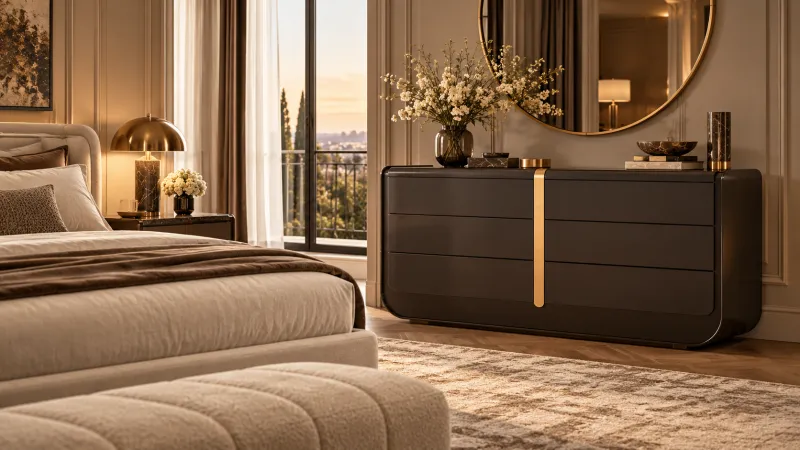
What Size Dresser Fits Your Bedroom? A Simple Measurement Guide
Posted by Elena Voss / Luxury Bathroom Furniture / October 20, 2026
A beautiful dresser can make a bedroom feel complete. It provides space for clothing, keeps everyday essentials organised and adds character to the interior. But even the most elegant dresser can become inconvenient when its size does not match the room.
Imagine choosing a wide marble-top dresser for your bedroom, only to discover that the drawers cannot open fully because the bed is too close. Or placing a tall dresser against a wall where it makes the room feel smaller than expected.
These problems can be avoided with a few simple measurements.
Whether you are furnishing a luxury home, a private villa or an elegant hotel suite, choosing the right bedroom dresser dimensions makes a noticeable difference.
This dresser size guide explains how to measure your space, select suitable furniture dimensions and leave enough room for drawers, walkways and surrounding furniture.
1. Why Choosing the Right Dresser Size Matters
A dresser should provide useful storage without taking away valuable floor space.
When a dresser is too large, it can make walking around the bedroom uncomfortable. Drawers may become difficult to open, and nearby furniture can feel crowded.
A dresser that is too small may not provide enough storage or look balanced against a large wall.
The ideal dimensions depend on your bedroom layout, storage requirements and existing furniture.
For example, a large master bedroom may accommodate a wide dresser with several drawers, while a smaller guest bedroom may benefit from a taller, narrower design.
In luxury interiors, furniture proportions are particularly important. A well-sized dresser should complement the bed, bedside tables and surrounding architectural details.
Understanding what size dresser for bedroom layouts works best begins with measuring the available space.
2. Standard Bedroom Dresser Dimensions
Dressers are available in different widths, heights and depths.
Although exact measurements vary between manufacturers, common dimensions provide a useful starting point.
Small Dressers
Small dressers generally measure approximately 60–100 cm wide, 40–50 cm deep and 70–100 cm high.
They are suitable for compact bedrooms, guest rooms and smaller spaces where additional storage is needed.
Medium Dressers
Medium dressers commonly measure around 100–150 cm wide, 40–55 cm deep and 75–100 cm high.
These dimensions work well in many standard bedrooms, providing storage without occupying an excessive amount of wall space.
Large Dressers
Large dressers may measure approximately 150–200 cm wide, 45–60 cm deep and 75–110 cm high.
They are often suitable for spacious master bedrooms, luxury suites and private residences.
These measurements are general guidelines rather than fixed industry standards. Always check the actual product specifications before purchasing.
3. How to Measure Your Bedroom Before Buying a Dresser
Before choosing a dresser, measure the area where you plan to place it.
Start with the available wall width.
Measure the distance between nearby doors, windows, wardrobes or other furniture.
Next, measure the available floor depth. This is the distance from the wall to the nearest obstruction, such as a bed or opposite wall.
Finally, check the height of the available wall space.
Windows, mirrors, decorative mouldings and wall-mounted lighting may affect how tall your dresser can be.
Write down these three measurements before comparing products.
A useful approach is to mark the planned dresser footprint on the floor using removable painter's tape.
This helps you understand how much space the furniture will occupy before it arrives.
For bedrooms with unusual layouts, measure several points because walls and available floor space may not be perfectly uniform.
4. How to Calculate the Ideal Dresser Width
The width of your dresser should suit the available wall space while leaving enough room around the furniture.
A simple starting formula is:
Maximum dresser width = Available wall width − Required side clearance
For example, imagine you have 220 cm of clear wall space.
If you want to leave 20 cm on each side, the calculation becomes:
220 cm − 40 cm = 180 cm.
In this situation, a dresser measuring up to approximately 180 cm wide could fit comfortably within the planned space.
However, side clearance is not always necessary against an empty wall. The amount required depends on nearby furniture, doors and architectural details.
For a balanced appearance, avoid selecting furniture that fills every centimetre of the available wall.
This is particularly important with decorative Baroque dressers featuring curved fronts, carved details or projecting handles.
5. How Much Space Is Needed to Open Dresser Drawers?
Drawer clearance is one of the most important measurements when choosing a dresser.
A dresser may fit perfectly against the wall but become difficult to use if there is insufficient space in front of it.
Most drawers extend outward when opened. The exact extension depends on the drawer depth and runner design.
As a practical guide, allow approximately 40–60 cm for drawer extension, depending on the model.
You should also provide additional space for a person to stand comfortably while accessing the drawers.
For example, if a dresser has drawers that extend 45 cm, allowing another 50–60 cm for a person may require approximately 95–105 cm of clear space in front during use.
A useful planning formula is:
Required access space = Drawer extension + Space for the user
Always confirm actual drawer extension measurements where available.
This is particularly important when placing a dresser opposite a bed.
6. What Is the Best Distance Between a Dresser and a Bed?
Many bedrooms have a dresser positioned opposite or beside the bed.
This arrangement can work beautifully, but it requires careful planning.
As a general guideline, aim for approximately 75–90 cm of clear walking space between furniture pieces.
Where drawers open directly towards the bed, additional space may be needed.
For example, a dresser measuring 50 cm deep placed opposite a bed must leave enough room for both drawer extension and comfortable access.
If the space between the dresser and bed is only 60 cm, some drawers may be difficult to use.
In spacious luxury bedrooms, providing more clearance can make movement feel easier.
The best arrangement allows someone to open the drawers without blocking the main route through the room.
7. Choosing a Dresser for Small Bedrooms
Smaller bedrooms require furniture that makes good use of limited space.
A wide dresser may provide generous storage, but it can also reduce the available walking area.
In these situations, a tall, narrow dresser may be more practical.
Vertical designs use less wall width while offering several storage compartments.
However, taller furniture requires particular attention to stability.
Choose furniture that meets applicable safety requirements and follow the manufacturer's wall-anchoring instructions.
When planning a compact bedroom, avoid placing a dresser where it blocks doors, wardrobes or windows.
A simple design with limited projecting details may also make movement easier.
For small luxury bedrooms, choosing suitable bedroom dresser dimensions helps maintain a comfortable and uncluttered appearance.
8. Choosing a Dresser for Large Luxury Bedrooms
A spacious bedroom offers more flexibility when selecting furniture.
Wide dressers with decorative finishes can complement large beds, upholstered headboards and elegant bedside tables.
In traditional European interiors, a Baroque dresser with carved details and a marble top can become an attractive feature against a spacious wall.
Contemporary bedrooms may benefit from long, low dressers with clean lines and smooth surfaces.
However, larger furniture should still be proportionate to the room.
A very wide dresser may appear overwhelming when placed beneath a small mirror or between narrow architectural features.
For an elegant arrangement, consider the visual relationship between the dresser, bed and surrounding furniture.
A well-proportioned layout generally feels more comfortable than one filled with oversized pieces.
9. Dresser Height: Should You Choose Tall or Low?
Dresser height affects both storage capacity and the overall appearance of the bedroom.
Low dressers generally provide a broad top surface suitable for decorative accessories, lamps and mirrors.
They are often attractive beneath large wall mirrors or framed artwork.
Tall dressers provide additional vertical storage while occupying less floor width.
However, their upper drawers may be less convenient for some users, and they require appropriate stability precautions.
For bedrooms with high ceilings, taller furniture can complement the proportions of the room.
In smaller interiors, low furniture may help maintain a more open appearance.
When selecting dresser height, consider who will use the furniture and whether the drawers can be reached comfortably.
10. Choosing Dresser Dimensions for Luxury Hotels
Hotel bedrooms require furniture that combines attractive design with practical everyday use.
A dresser in a luxury hotel suite should provide convenient storage without restricting movement around the bed or entrance.
Guests may also use the dresser top for personal belongings, decorative accessories or small luggage items.
In compact hotel rooms, a narrow dresser may be preferable to a larger storage unit.
For spacious suites, a broad dresser can complement other coordinated furnishings.
Hotel designers should also consider cleaning access, furniture durability and the needs of different guests.
A suitable dresser should work naturally with the room layout while maintaining comfortable circulation.
Explore our luxury hotel furniture collection for complementary furnishings designed for elegant hospitality interiors.
11. Common Dresser Sizing Mistakes to Avoid
A few common mistakes can make even a beautiful dresser inconvenient.
Ignoring Drawer Clearance
Always check that drawers can open fully without touching the bed or nearby furniture.
Measuring Only the Furniture Width
Depth and height are equally important when determining whether a dresser fits properly.
Overlooking Decorative Details
Carved edges, handles and curved fronts may extend beyond the main furniture body.
Blocking Bedroom Walkways
Leave sufficient space to move comfortably around the room.
Choosing Size Based Only on Appearance
A dresser should suit both your storage requirements and the available bedroom space.
Taking these details into account can help prevent unnecessary problems after delivery.
Final Thoughts: Find the Right Dresser for Your Bedroom
Choosing the right dresser is about balancing useful storage, comfortable movement and attractive design.
Start by measuring your available wall width, floor depth and height.
Then consider drawer extension, walking clearance and the distance from nearby furniture.
A smaller dresser may be ideal for a compact bedroom, while a large decorative design can work beautifully in a spacious luxury suite.
By following this dresser size guide, you can choose furniture that fits naturally into your bedroom and remains comfortable to use.
Explore our luxury dresser collection to discover elegant storage furniture for private residences, luxury homes and sophisticated hotel interiors.
RECENT POSTS
-
What Size Dresser Fits Your Bedroom? A Simple Measurement Guide
October 20, 2026
-

Swivel vs Fixed Bar Stools: Which Is Better for Everyday Use?
October 20, 2026
-

How to Protect Luxury Outdoor Furniture Through Winter: A Complete Care Guide
October 19, 2026
-

How Luxury Furniture Delivery Works Across Europe: A Complete Shipping Guide
October 19, 2026
-

How to Clean and Protect a Marble-Top Table: A Complete Care Guide
October 18, 2026
-

How to Clean a Crystal Chandelier Without Damaging the Finish
October 18, 2026
-

Dining Table Size Guide: How Many Chairs Fit Without Feeling Cramped?
October 17, 2026
-

Round vs Square Coffee Tables for Family Living Rooms: Which Shape Works Best?
October 17, 2026
-

The New Language of Home Entertaining: Modern Bar Furniture for Sophisticated Interiors
October 16, 2026
-

The Right Glow for Every Space: A Guide to Choosing the Perfect Floor Lamp
October 16, 2026


