





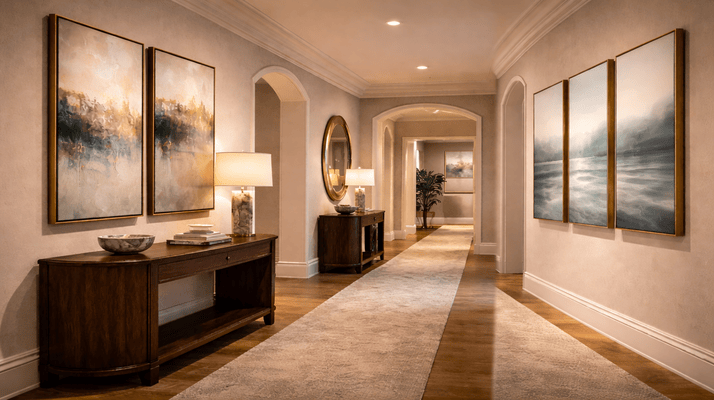
Hallway Harmony: Using Wall Art Sets to Guide Movement and Welcome Guests
Posted by Luxury Group International Design Team / Luxury Wall Decoration / April 12, 2026
The hallway is often the most neglected artery of the home. We treat it as a transitional tunnel—a way to get from the front door to the living room—rather than a destination. However, in the world of high-end interior design, the corridor is the ultimate canvas for setting a home’s tone. It is the "handshake" of your house, the first impression that tells guests who you are and how they should feel within your walls.Creating a sense of flow in these narrow spaces requires more than just a fresh coat of paint. To achieve true balance, savvy homeowners utilize Wall Art Sets to create visual rhythm, lead the eye, and turn a static passage into a curated journey.
The Psychology of the Corridor: First Impressions Matter
When a guest enters your home, their eyes immediately search for a focal point. A long, empty hallway can feel daunting or cold, like an endless gallery without a purpose. By strategically placing designer wall art, you break up the monotony and provide "visual anchors" that make the walk through your home feel shorter and more engaging.
The goal is to move beyond the "one-and-done" approach of hanging a single small photo. To command authority in a transitional space, you need a cohesive narrative. This is where a curated set becomes invaluable. It provides a sense of continuity that bridges the gap between the entryway and the heart of the home.
Establishing Visual Rhythm with Wall Art Sets
Rhythm is a core principle of design. In a hallway, you create rhythm through repetition. Imagine walking past a series of three or four coordinated frames; your brain instinctively follows the pattern, which subconsciously guides your movement forward.
Creating the "Movement Guide"
• The Entry Anchor: Place the most vibrant piece of your Wall Art Sets near the entrance to draw people in.
• The Mid-Way Transition: Use smaller, more intricate framed wall art work in the center of the hallway to encourage a slight pause or "slow down" in pace.
• The Destination Draw: Place a final, bold piece at the very end of the corridor. This acts as a beacon, pulling the guest toward the next room.
By alternating the spacing and maintaining a consistent "eye-level" height, you ensure that the corridor feels balanced and intentional rather than cluttered.
Designing for Narrow Spaces: The Depth Illusion
One of the primary challenges of hallway design is the lack of width. Traditional furniture can often make a corridor feel cramped. However, designer wall art adds "visual depth" without taking up a single inch of floor space.
If your hallway feels narrow, consider using Wall Art Sets with a "landscape" or "horizon" theme. The horizontal lines in the artwork subconsciously suggest that the walls are further apart than they actually are. Conversely, if you have high ceilings but short walls, vertical sets can bridge that gap, making the space feel more proportional and grand.
Framing the Narrative: The Power of Consistency
For a hallway to feel harmonious, the framing must be as considered as the art itself. High-quality framed wall art work provides a professional, "museum-grade" finish that elevates the entire home.
Consistency in the frames—whether you choose sleek black metal, warm natural wood, or ornate gold—acts as a unifying thread. When the frames match across the entire set, you can afford to be more adventurous with the subject matter inside. This allows you to mix abstract prints with botanical sketches or architectural photography while still maintaining a polished, cohesive aesthetic.
Practical Styling: The Hallway Makeover Checklist
Before you pick up the hammer, consider these practical tips for a seamless hallway transformation:
• Lighting is Key: Hallways are often dark. Supplement your art sets with picture lights or directional ceiling spots. This makes the designer wall art pop and ensures the corridor feels safe and welcoming.
• The "Two-Thirds" Rule: When hanging a set above a console table in an entryway, ensure the artwork covers roughly two-thirds of the table’s width. This prevents the art from looking like it is "floating" in space.
• Avoid Overcrowding: Give your Wall Art Sets room to breathe. Leave at least 3 to 5 inches between each frame to ensure the set feels like a singular installation rather than a jumble of unrelated pieces.
Sharing the Journey: Your Hallway Story
We often find that the most rewarding part of a home makeover is the feedback from guests. A well-designed hallway invites questions and sparks conversation before guests even reach the sofa. Have you recently swapped a bare wall for a stunning set of prints? The transformation from "forgotten hall" to "stunning gallery" is one of the most satisfying design wins a homeowner can experience.
Conclusion: Turning Transitions into Destinations
The hallway should never be an afterthought. It is the connective tissue of your life, and it deserves the same level of curation as your living or dining room. By utilizing Wall Art Sets, you create a rhythmic, engaging environment that guides movement and welcomes everyone with open arms.
Investing in high-quality framed wall art work is the most effective way to introduce architectural grace and personal style without the need for a major renovation. Turn your next transition into a journey of beauty and harmony.
RECENT POSTS
-
The Art of Hospitality on Wheels: How Luxury Trolleys Elevate Boutique Hotel Experiences
September 25, 2026
-
The Art of Grandeur: How Baroque Coffee Tables Transform Luxury Living Spaces
September 25, 2026
-
The Art of Entertaining: How Luxury Bar Furniture Transforms Sophisticated Interiors
September 24, 2026
-
The New Art of Rest: Curating a Wellness-Focused Luxury Bedroom
September 24, 2026
-
Framed Prints That Bring Effortless European Elegance to Apartment Interiors
September 23, 2026
-
How Crystal Chandelier Lighting Transforms Light, Height and Luxury Interiors
September 23, 2026
-
Sculptural Illumination: How Contemporary Floor Lamps Are Becoming Modern Art Statements
September 22, 2026
-

The Art of Choosing a Luxury Table Clock: A Guide to Size, Style & Placement
September 21, 2026
-
Elegant Wall Lamps: The Secret to Warmer, More Characterful Luxury Interiors
September 21, 2026
-
Pairing Luxury TV Units with Living Room Furniture: Create Cohesive Elegance in Modern Homes & Hotel
September 20, 2026