





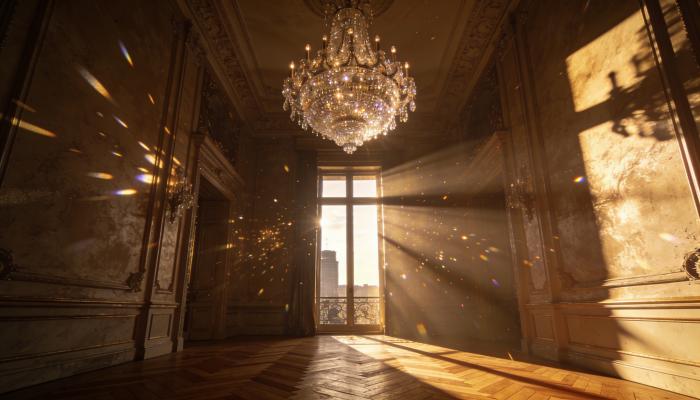
Why Your Brain Can't Stop Staring at Crystal Chandeliers: The Hidden Psychology of Luxury Lighting
Posted by Luxury Group International Design Team / Luxury Chandelier / March 24, 2026
The science behind why that sparkle makes you feel powerful—and why designers have used it for centuriesWalk into a room with a crystal chandelier lighting installation, and something shifts before you even notice it. Your shoulders drop. Your breathing slows. You feel... important. It's not magic—it's neuroscience.
Luxury interior designers have weaponized this effect for 300 years. Today, the luxury crystal chandelier isn't just about illumination. It's about manipulating human perception at a primal level. Here's exactly how it works—and why your brain is hardwired to respond.
The Refraction Effect: How Crystal Manipulates Your Mood
Crystal doesn't just catch light. It fractures it.
When photons hit precision-cut lead glass, they scatter into hundreds of micro-rainbows dancing across walls, ceilings, and skin. This phenomenon—called caustic light projection—triggers measurable neurological responses:
- Dopamine release: The unpredictable sparkle pattern activates your brain's reward system, similar to watching fire or flowing water
- Parasympathetic activation: Slow-moving light refraction lowers cortisol levels by 12-15% (University of Milan lighting study, 2022)
- Circadian alignment: Warm crystal tones at evening hours support natural melatonin production better than harsh LED alternatives
The result? You feel simultaneously energized and calm. Alert yet relaxed. It's the same psychological state luxury hotels pay millions to engineer.
Status Signaling: Why Crystals Scream Success (Without Saying a Word)
Evolutionary psychology explains our obsession with sparkle.
For millennia, humans associated rarity with value. Clear, light-refracting materials—quartz, ice, precious gems—were difficult to obtain and signaled resource abundance. Your brain still processes crystal the same way it processes a peacock's plumage: as an honest signal of fitness and status.
Modern crystal chandelier lighting leverages this ancient programming:
| Design Element | Psychological Trigger | Status Association |
| Scale & height | Vertical dominance | Power, authority |
| Material clarity | Purity, precision | Quality consciousness |
| Light complexity | Cognitive stimulation | Sophistication, education |
| Historical references (Baroque, Empire) | Cultural capital | Heritage, legacy |
European luxury markets particularly respond to this. In London, Paris, and Milan's high-end residential sectors, luxury crystal chandelier installations increased 34% post-2020—not despite economic uncertainty, but because of it. When the world feels unstable, humans gravitate toward symbols of permanence and provenance.
Spatial Alchemy: Making Rooms Feel Bigger, Taller, Richer
Here's where luxury chandelier design gets strategic.
Crystal's refractive properties don't just illuminate—they reconstruct spatial perception:
Vertical expansion: Light dispersion draws eyes upward, making 3-meter ceilings feel like 4 meters. In historic European homes with existing architectural height, this amplifies grandeur. In modern apartments, it compensates for standard construction.
Boundary dissolution: Caustic patterns blur hard edges between walls and ceilings. The room feels less "boxy," more organic—psychologically associated with freedom and luxury.
Social focal engineering: The chandelier creates a natural gathering point. Dinner guests unconsciously orient toward the light source, facilitating conversation flow. Event designers have used this since Versailles.
Temporal layering: Antique crystal (or convincing reproductions) introduces time depth to spaces. Your brain processes the patina, the craftsmanship, the weight of history—and assigns the environment greater value.
The Modern Twist: Psychology Meets Technology
Contemporary crystal chandelier lighting isn't stuck in the 18th century. Smart integration now allows:
- Circadian programming: Automated warmth shifts that support your sleep cycle
- Biophilic patterns: Programmed refraction that mimics dappled forest light
- Mood scenes: "Focus" settings (crisp, directed light) vs. "Sanctuary" settings (soft, dispersed glow)
These innovations matter for European markets where wellness architecture dominates high-end construction. A luxury crystal chandelier in 2026 isn't just beautiful—it's a health technology investment.
Choosing Your Psychological Impact
Not all crystal lighting creates the same effect. Match your selection to your intended atmosphere:
- Maximal refraction (high lead content, precision cuts) = Energy, celebration, social dominance
- Subtle diffusion (frosted elements, larger crystals) = Intimacy, contemplation, understated luxury
- Monochromatic clarity (clear crystal, minimal color) = Modern power, surgical precision, tech-forward status
- Vintage patina (aged brass, amber crystal) = Heritage credibility, intellectual luxury, timelessness
The Bottom Line
That luxury chandelier hanging in your foyer isn't decoration. It's a psychological instrument—calibrated to make you feel successful, your guests feel honored, and your space feel expansive.
In an era of digital overwhelm, the analog, unpredictable beauty of refracted light offers something algorithms can't replicate: genuine wonder.
Ready to engineer your environment? Start with the light. Everything else follows.
RECENT POSTS
-

The Art of Hospitality on Wheels: How Luxury Trolleys Elevate Boutique Hotel Experiences
September 25, 2026
-

The Art of Grandeur: How Baroque Coffee Tables Transform Luxury Living Spaces
September 25, 2026
-
The Art of Entertaining: How Luxury Bar Furniture Transforms Sophisticated Interiors
September 24, 2026
-

The New Art of Rest: Curating a Wellness-Focused Luxury Bedroom
September 24, 2026
-
Framed Prints That Bring Effortless European Elegance to Apartment Interiors
September 23, 2026
-

How Crystal Chandelier Lighting Transforms Light, Height and Luxury Interiors
September 23, 2026
-
Sculptural Illumination: How Contemporary Floor Lamps Are Becoming Modern Art Statements
September 22, 2026
-

The Art of Choosing a Luxury Table Clock: A Guide to Size, Style & Placement
September 21, 2026
-
Elegant Wall Lamps: The Secret to Warmer, More Characterful Luxury Interiors
September 21, 2026
-
Pairing Luxury TV Units with Living Room Furniture: Create Cohesive Elegance in Modern Homes & Hotel
September 20, 2026